preloader

Email Us

info@prorelixresearch.com

CRO For CE Marking Clinical Trials

Power medical device innovation through CE Marking Clinical Trials designed to support clinical evidence generation, safety & performance evaluation, & market readiness. From study planning to clinical data development, we enable confident CE certification with precision, speed, & execution aligned to European market expectations.

What is the CE Marking?

CE Marking is a certification symbol that confirms a product complies with the European Union’s (EU) health, safety, and environmental protection requirements and is mandatory for many products sold in the European Economic Area (EEA). It indicates that the manufacturer has assessed the product against applicable EU directives and regulations, enabling free movement of goods across EU member states. For regulated products such as medical devices, in vitro diagnostics, machinery, and electrical equipment, CE Marking may also require conformity assessments, technical documentation, and, in some cases, involvement of a Notified Body before the CE mark can be applied.

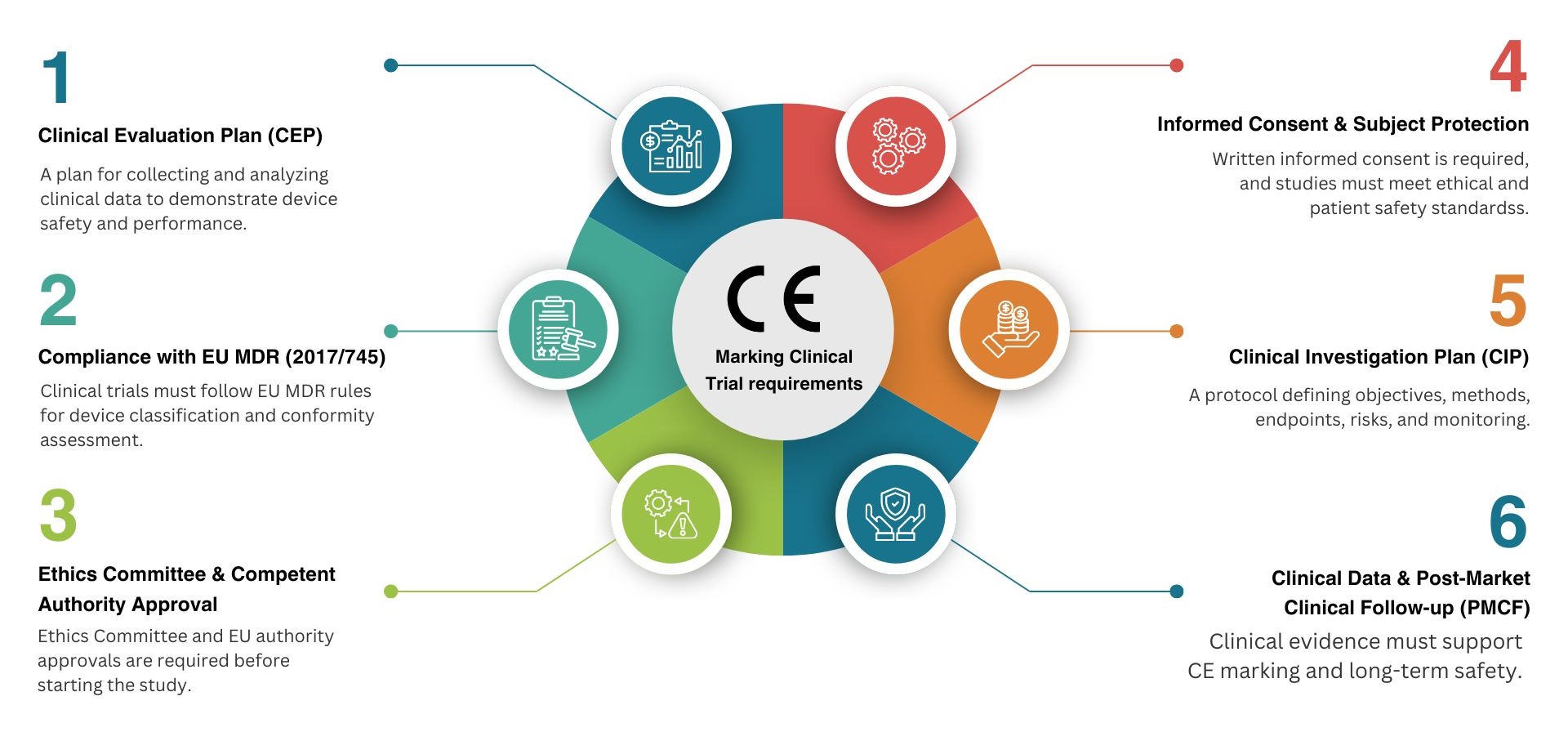
CE Marking Clinical Trial Requirements

CE marking for medical devices is ensuring that a product meets safety, health, and performance standards. Conducting clinical trials is a critical step in generating the evidence needed to support CE marking procedures. These trials help demonstrate that the device is safe, effective, and performs as intended in real-world conditions.

CRO for CE Marking Clinical Trial Requirements

CE Marking Clinical Trial Process

The CE Marking clinical trial process is a structured pathway required for medical device manufacturers to demonstrate the safety, performance, and clinical benefit of their devices before placing them on the European market. It ensures compliance with the EU Medical Device Regulation (MDR) and In Vitro Diagnostic Regulation (IVDR), helping manufacturers meet regulatory and patient safety requirements through well-planned clinical investigations, data collection, and clinical evaluation.

ProRelix Research, as a specialized CRO For CE Marking Clinical Trial Process, supports manufacturers across the full lifecycle by developing tailored regulatory and clinical strategies, preparing Clinical Evaluation Plans (CEP) and Clinical Investigation Plans (CIP), managing ethics and authority submissions, and overseeing site operations and GCP compliance. ProRelix Research also compiles Clinical Evaluation Reports (CER) for Notified Body review and provides Post-Market Clinical Follow-up (PMCF) support to ensure ongoing compliance and sustained market access in the European Union.

CE Marking Clinical Trial Process

CE Marking Clinical Trial Standards

ProRelix Research, a global CRO for CE marking clinical trial standards, helps medical device manufacturers navigate the complex regulatory and clinical requirements needed to demonstrate safety, performance, and compliance before entering the European market. Under the EU Medical Device Regulation (MDR) and In Vitro Diagnostic Regulation (IVDR), manufacturers must generate robust clinical evidence through clinical investigations or performance studies to support conformity assessment.

These standards require adherence to Good Clinical Practice (GCP), ethical approvals, risk management, and proper documentation to ensure patient safety and data integrity. Clinical trials conducted for CE Marking must align with applicable harmonized standards, ISO 14155, and regulatory guidance, ensuring that clinical data supports the intended use, benefit-risk profile, and regulatory approval of the device within the European Union.

CE Marking Clinical Trial Guidelines and Regulations

CE Marking clinical trial guidelines and regulations define the regulatory framework for conducting clinical investigations to demonstrate the safety, performance, and clinical benefit of medical devices in the European Union. Under the EU Medical Device Regulation (EU MDR 2017/745) and In Vitro Diagnostic Regulation (IVDR 2017/746), manufacturers must comply with strict requirements for clinical evidence, study design, ethical approvals, and regulatory submissions to support CE marking.

Clinical investigations must follow Good Clinical Practice standards (ISO 14155) to ensure patient safety, ethical conduct, and data integrity. Sponsors are responsible for obtaining approvals from ethics committees and competent authorities, maintaining essential documentation, managing risk and adverse event reporting, and meeting EUDAMED registration and reporting obligations, where applicable, to ensure full regulatory compliance and successful EU market access.

When is CE Marking Required

When is CE Marking Required?

CE marking is required for products sold in the European Economic Area (EEA) that fall under specific EU directives or regulations. It confirms that a product meets essential EU safety, health, and environmental protection requirements, allowing it to be legally marketed across Europe. Products such as medical devices, in vitro diagnostics, electrical equipment, machinery, toys, and construction products typically require CE marking. For example, medical devices and diagnostic tools must carry a CE mark before being placed on the European market. CE marking is a legal requirement, not a quality label, and non-compliance can lead to fines, recalls, or market restrictions. Manufacturers must complete the required conformity assessments and maintain proper technical documentation. For organizations seeking support of expert guidance as a CRO for CE Marking Clinical Trial requirements, helping ensure regulatory compliance. ProRelix Research also offers strategic support for CE Marking Clinical Trials in the USA, enabling alignment with regulatory expectations.

CRO For CE Marking Clinical Trial Approval Procedures

CE Marking Clinical Trial Compliance

Ensuring compliance with CE marking compliance is essential for medical devices to be legally marketed in the European Economic Area (EEA). Clinical trials are a key part of this process, providing the necessary evidence of safety, performance, and effectiveness. 

Clinical trials must align with EU Medical Device Regulations (MDR) and relevant harmonized standards to ensure legal compliance and safety.

Conduct thorough risk assessments to identify potential hazards and implement measures to mitigate them, demonstrating the device’s safety.

Obtain approvals from ethics committees and regulatory authorities before initiating clinical studies, ensuring adherence to local and EU guidelines.

Design trials that accurately measure device performance and effectiveness while maintaining scientific rigor and patient safety.

Maintain accurate, traceable, and secure data throughout the study. Complete documentation is critical for CE marking submission and audits.

Develop plans to monitor device performance after market release, ensuring ongoing compliance with CE marking requirements.

Key Takeways

Not always. Clinical trials are required when existing clinical data, literature, or equivalence evidence is insufficient to demonstrate safety and performance under EU MDR/IVDR. High-risk devices (Class IIb, III, and many IVDs) are more likely to require clinical investigations.

A clinical investigation is required for new or significantly modified devices, when clinical evidence is insufficient, when equivalence cannot be proven, for Class III or implantable devices, or when requested by the Notified Body to support regulatory compliance.

CE marking clinical trials typically take between 9 and 24 months, depending on device class, study design, patient enrollment, follow-up duration, and regulatory review timelines.

A CRO manages clinical strategy, protocol development, regulatory and ethics submissions, site management, data collection, statistical analysis, and preparation of clinical documentation such as CERs and PMCF reports.

Required documents include the Clinical Investigation Plan, Investigator’s Brochure, informed consent forms, ethics approvals, risk management documentation, Clinical Study Report, and the Clinical Evaluation Report.

Yes, CE marking clinical trials can be conducted outside Europe, including in India and other regions, provided the study complies with ISO 14155, EU MDR requirements, and GCP standards, and is acceptable to the Notified Body.

A Clinical Evaluation Report is a mandatory MDR document that assesses all available clinical data to demonstrate device safety and performance and is a critical component of CE marking submissions.

An experienced CRO can accelerate approval by designing MDR-compliant studies, aligning endpoints with regulatory requirements, minimizing gaps in evidence, and preparing strong CER and PMCF documentation aligned with Notified Body expectations.

Notified Bodies review clinical evidence, assess CERs, evaluate PMCF plans, and determine whether the clinical data adequately supports conformity with EU MDR General Safety and Performance Requirements.

Patient enrollment in Europe is not mandatory; however, patient populations, standard of care, and data quality must be representative and acceptable to the Notified Body for CE marking purposes.

Progressive Solutions With ProRelix Research

From Concept to Clinical Success

Bringing new therapies requires accuracy, efficiency, and regulatory care. We offer clinical trial solutions that reduce risk, shorten timelines, and ensure compliance, turning ideas into successful outcomes.

Healthcare Professional

Subscribe to our Newsletter

Be the first to know the latest trends in clinical research, real-world case studies, and industry secrets.

[fluentform id="3"]
prorelix research

ProRelix Research is the rapidly growing Contract/ Clinical Research Organization (CRO) with multi-country service capability supporting phase 1, 2, 3, & 4 clinical trials of Pharma, Biotech, Biopharma, Medical Device, Nutraceutical & Herbal companies to conduct in the USA, India, Europe & South East Asia.