



A review of SDTM implementation trends across therapeutic areas, highlighting complexity, regulatory focus, and future considerations.
Table of Contents
Abstract
The Study Data Tabulation Model (SDTM) remains the foundational standard for regulatory data submission, yet its implementation continues to evolve unevenly across therapeutic areas. Differences in disease complexity, endpoint heterogeneity, data acquisition technologies, and regulatory scrutiny have driven distinct SDTM interpretation and application patterns. This review examines how SDTM implementation has matured across major therapeutic domains, highlighting emerging trends, persistent challenges, and forward-looking considerations shaping regulatory-grade clinical data.
Introduction
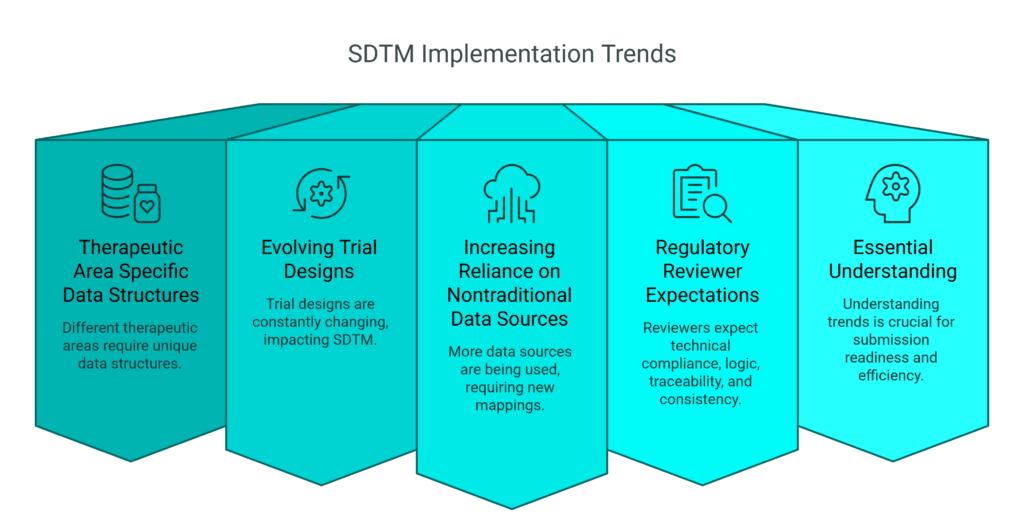
While SDTM has been embedded in regulatory expectations for more than a decade, its operationalization is far from uniform. Therapeutic area specific data structures, evolving trial designs, and increasing reliance on nontraditional data sources have pushed sponsors and CROs beyond standard SDTM mappings. Regulatory reviewers now expect not only technical compliance, but also therapeutic logic, traceability, and consistency across integrated development programs.
Understanding SDTM implementation trends across therapeutic areas is therefore essential, not merely for submission readiness, but for sustaining review efficiency, cross study integration, and lifecycle data reuse.
Oncology: SDTM Under Complexity Pressure
Oncology continues to drive the most advanced and nuanced SDTM implementations. Complex dosing regimens, adaptive designs, and multiple lines of therapy challenge traditional domain assumptions. Tumor response data, particularly when aligned to RECIST and evolving response criteria, has driven increased customization within TU, TR, and RS domains, with heightened regulatory sensitivity around derivation transparency.
Recent trends indicate greater emphasis on longitudinal traceability, ensuring that baseline tumor assessments, progression events, and subsequent therapies are clearly distinguishable across visits and disease milestones. Additionally, oncology trials increasingly incorporate molecular and biomarker datasets, requiring disciplined alignment between LB, MB, and supplemental domains. Regulators now routinely assess whether SDTM structures meaningfully reflect clinical decision points, rather than merely satisfying technical conformance.
Cardiovascular and Metabolic Diseases: Stability with Precision
Cardiovascular and metabolic studies represent some of the most mature SDTM implementations, benefiting from historically standardized endpoints and well established clinical assessment patterns. Domains such as VS, LB, and AE are typically straightforward, yet recent trends show heightened scrutiny around adjudicated endpoints, composite outcomes, and time to event data.
Implementation patterns increasingly reflect a separation between raw clinical observations and analysis driving endpoints, with careful attention to controlled terminology and visit structure. As decentralized data sources such as wearables gain traction in this space, SDTM models are being extended to preserve interpretability without compromising regulatory familiarity.
Central Nervous System: Navigating Subjectivity and Scale
CNS trials present unique SDTM challenges due to their reliance on complex scales, rater dependent assessments, and longitudinal cognitive measurements. While domains like QS and SC remain central, recent implementation trends focus on improving traceability between source instruments, visit timing, and analysis variables.
Regulatory feedback increasingly highlights inconsistencies in scale versioning, visit alignment, and baseline definitions. As a result, sponsors are adopting more rigorous SDTM annotation strategies and controlled terminology governance to minimize interpretive ambiguity. CNS programs now often embed SDTM considerations earlier in protocol design to prevent downstream reconciliation issues.
Rare Diseases: Flexibility Within Constraint
Rare disease trials have accelerated the need for SDTM flexibility without undermining standardization. Small sample sizes, bespoke endpoints, and novel biomarkers frequently require thoughtful use of supplemental qualifiers or custom domain extensions.
A notable trend is the increasing regulatory tolerance for nontraditional SDTM structures, provided clinical intent is clearly documented and traceable. Reviewers place greater emphasis on define.xml clarity, annotated CRFs, and reviewer guides to compensate for unconventional data representations. The shift reflects a pragmatic balance between SDTM rigor and clinical feasibility.
Infectious Diseases and Vaccines: Scale and Speed
Large scale infectious disease and vaccine trials stress SDTM systems through volume, rapid enrollment, and global site diversity. Implementation trends emphasize consistency, automation, and early standard locking to support accelerated submission timelines.
Exposure, immunogenicity, and safety domains are often scrutinized for alignment across pooled analyses and integrated summaries. Recent regulatory interactions suggest growing expectations around standardized handling of protocol deviations, concomitant medications, and adverse events in high enrollment studies, where minor inconsistencies can materially impact review efficiency.
Emerging Trends Shaping SDTM Implementation
Across therapeutic areas, several cross cutting trends are evident. First, SDTM is increasingly viewed as a clinical narrative tool rather than a purely technical deliverable. Regulators expect data structures to reflect disease progression, treatment intent, and clinical decision making logic.
Second, integration readiness is becoming a primary success metric. Programs with multiple studies now design SDTM frameworks prospectively to enable seamless pooling, rather than retrofitting consistency at submission.
Finally, the growing use of real world and digital health data is challenging traditional SDTM assumptions, driving innovation in controlled terminology application, timing variables, and domain interoperability.
Therapeutic Area–Specific SDTM Implementation Trends and Regulatory Focus
| Therapeutic Area / Section | Key SDTM Implementation Trends | Challenges | Regulatory Focus |
| Oncology | Advanced longitudinal traceability, integration of biomarkers, customized TU/TR/RS domains | Complex dosing, adaptive designs, multiple lines of therapy, tumor response criteria | Derivation transparency, clinical intent alignment, reviewer traceability |
| Cardiovascular & Metabolic | Mature, standardized domains (VS, LB, AE), separation of raw vs analysis endpoints | Handling adjudicated endpoints, composite outcomes, integrating wearables | Consistency, controlled terminology, data integrity for pooled analyses |
| Central Nervous System (CNS) | Improved traceability of scales and cognitive assessments, early SDTM annotation | Subjective rater assessments, scale versioning, visit alignment | Baseline definitions, minimize interpretive ambiguity, protocol alignment |
| Rare Diseases | Flexible SDTM structures, use of supplemental qualifiers and custom domains | Small sample sizes, bespoke endpoints, novel biomarkers | Clear documentation, define.xml clarity, reviewer guides to support unconventional structures |
| Infectious Diseases & Vaccines | Automation, early standard locking, alignment across pooled studies | Large enrollment, rapid timelines, global site diversity | Standardized handling of deviations, concomitant meds, and adverse events |
Conclusion
SDTM implementation has matured beyond compliance into a strategic discipline shaped by therapeutic complexity and regulatory expectations. While core standards remain consistent, their application increasingly reflects disease specific realities, evolving trial methodologies, and the demand for data interpretability at scale.
Sponsors and CROs that align SDTM design with therapeutic intent, rather than treating it as a post hoc mapping exercise, are better positioned to support efficient regulatory review, cross study integration, and long term data value. As therapeutic innovation continues to accelerate, SDTM implementation will remain a critical interface between clinical science and regulatory decision making.
Read More: CDISC Standards for Biostatistics and Clinical Data Management
References
- Clinical Data Interchange Standards Consortium (CDISC).
Study Data Tabulation Model Implementation Guide (SDTMIG).
https://www.cdisc.org/standards/foundational/sdtm - U.S. Food and Drug Administration (FDA).
Providing Regulatory Submissions in Electronic Format — Standardized Study Data Guidance for Industry.
https://www.fda.gov/regulatory-information/search-fda-guidance-documents/providing-regulatory-submissions-electronic-format-standardized-study-data - Pinnow E, Smith J, Williams H.
Regulatory Review Perspectives on SDTM and Define XML. Therapeutic Innovation and Regulatory Science.
https://link.springer.com/journal/43441
FAQs:
Why does SDTM vary by therapeutic area?
Implementation differs due to disease complexity, endpoint types, and data collection methods, with areas like oncology and CNS requiring more nuanced modeling.
Which therapeutic area is most challenging SDTM implementation ?
Oncology is the most complex due to adaptive designs, multiple therapies, and biomarker integration needing advanced SDTM mapping.
How do regulators assess SDTM quality?
Regulators review not just structure, but also clinical interpretability, traceability, and alignment with therapeutic intent.
How does real-world data affect SDTM?
Real-world and digital data introduce high-frequency and nontraditional variables, requiring flexible yet compliant SDTM models.
How to ensure consistent SDTM across studies?
Early standards governance, program-level conventions, and prospective mapping reduce inconsistencies and streamline regulatory review.
