


Operationalize FDA guidance for industry decentralized clinical trials with ProRelix Research. 21 CFR Part 11 eConsent, eCOA, and DtP logistics. Request a quote.
Table of Contents
Operationalizing FDA Guidance for Industry on Decentralized Clinical Trials: Mitigating Sponsor Risk in Hybrid Studies
Executive Summary
As global biopharmaceutical and biotechnology sponsors pivot from exploratory pilot programs to enterprise-level hybrid study execution, regulatory compliance remains the definitive factor in clinical trial success. The U.S. Food and Drug Administration’s (FDA) final guidance framework, “Conducting Clinical Trials With Decentralized Elements“, has established clear operational standards across the industry. The agency’s focus has evolved from abstract decentralization to granular, risk-based quality management. Navigating this regulatory landscape requires more than standalone digital health tools; it demands an integrated, audit-ready operational infrastructure.
ProRelix Research, a leading global Contract Research Organization (CRO), bridges the gap between regulatory requirements and complex study execution. Powered by our proprietary eClinical platform, ProCTTH, ProRelix Research delivers complete study management, site orchestration, and full data integrity designed specifically for U.S. biopharma sponsors and international research programs.
Regulatory Core: Translating FDA Guidance into Operational Quality
The FDA’s guidance clarifies that decentralized clinical trial (DCT) activities ranging from direct-to-participant (DtP) drug distribution to remote telehealth visits and local healthcare provider (HCP) integration remain subject to the same regulatory standards (21 CFR Parts 312 and 812) and Good Clinical Practice (GCP) principles as traditional site-based studies.
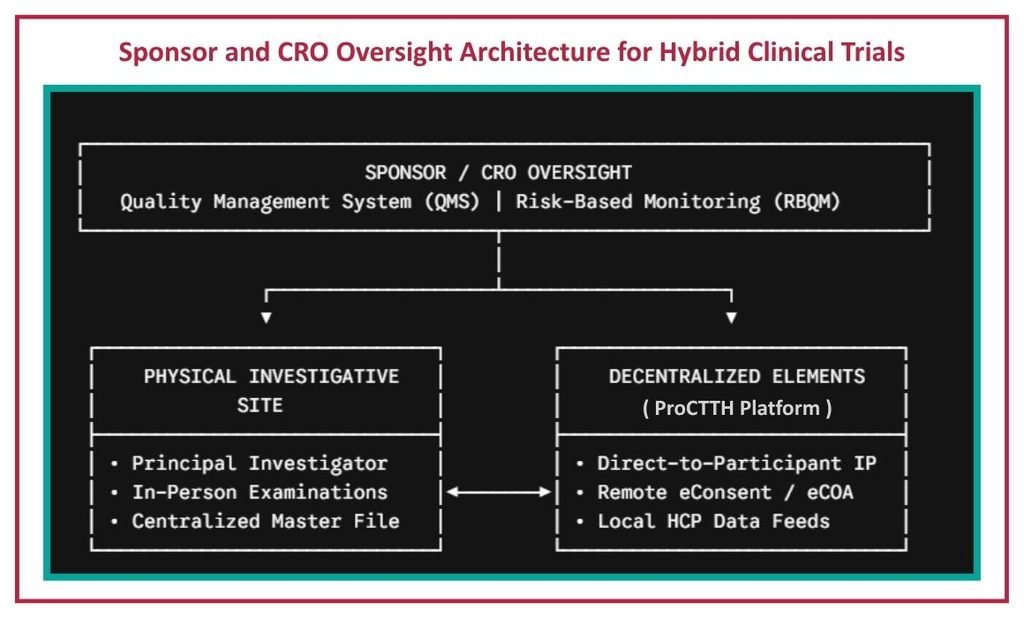
The FDA evaluates protocols based on individual decentralized elements. To operationalize the FDA guidance for industry decentralized clinical trials, sponsors and CRO partners must address four key compliance requirements:
1. Uncompromised Investigator Oversight:
Principal Investigators (PIs) remain legally and operationally responsible for trial participant safety and protocol-defined data integrity. While the FDA does not require formal delegation logs for local HCPs performing routine clinical procedures, established central oversight mechanisms and documented training for protocol-specific tasks ensure consistent execution and audit readiness.
2. Strict Data Integrity & 21 CFR Part 11 Compliance:
Software systems used to capture, aggregate, or transmit remote trial data must comply with 21 CFR Part 11. Complete audit trails, validated electronic signatures, version control, and verifiable data provenance are mandatory for regulatory inspection readiness.
3. Direct-to-Participant (DtP) IP Logistics:
Sponsors shipping investigational products (IP) directly to participant homes must implement temperature-tracked, validated chain-of-custody workflows. Real-time accountability, physical stability monitoring, and controlled disposal of unused IP must match traditional clinical site standards.
4. FDA Inspection Readiness & Record Centralization:
The FDA guidance recommends that clinical investigators designate a physical inspection location (typically corresponding to the address on Form FDA 1572 or the IDE application) with centralized access to electronic trial master files (eTMF) and source documentation to facilitate investigator interviews and regulatory review.
Implementing these requirements across global trial sites calls for a CRO partner with verified operational frameworks and integrated technology.
Mitigating Sponsor Risk: ProRelix Research and the ProCTTH Platform
As a leading global CRO, ProRelix Research has built its clinical operations to meet the regulatory, logistical, and data management standards defined by global health authorities.Central to our execution model is ProCTTH the proprietary eClinical and trial management platform developed by ProRelix Research. ProCTTH serves as a unified digital ecosystem that connects remote participant management, real-time data ingestion, local laboratory reporting, and risk-based site monitoring into a single 21 CFR Part 11-compliant platform.
Implementing these requirements across global trial sites calls for a CRO partner with verified operational frameworks and integrated technology.
Mitigating Sponsor Risk: ProRelix Research and the ProCTTH Platform
As a leading global CRO, ProRelix Research has built its clinical operations to meet the regulatory, logistical, and data management standards defined by global health authorities.Central to our execution model is ProCTTH the proprietary eClinical and trial management platform developed by ProRelix Research. ProCTTH serves as a unified digital ecosystem that connects remote participant management, real-time data ingestion, local laboratory reporting, and risk-based site monitoring into a single 21 CFR Part 11-compliant platform.
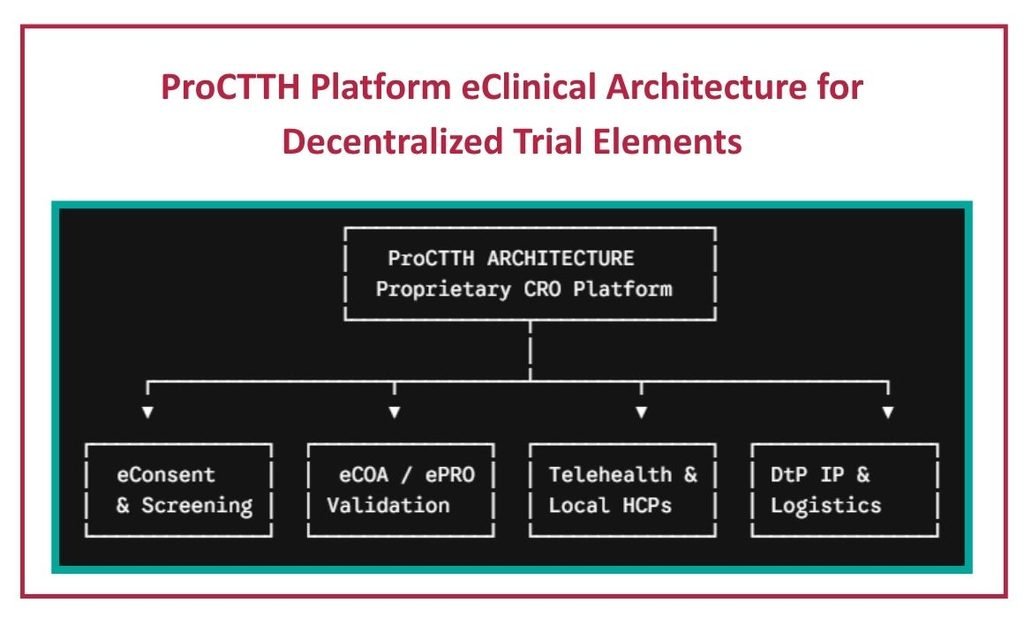
1. Unified 21 CFR Part 11 Electronic Data Architecture
Managing separate vendors for eConsent, eCOA/ePRO, and electronic data capture (EDC) introduces data silos, security risks, and audit vulnerabilities.
ProCTTH operates as a single source of truth across the study lifecycle:
Remote eConsent:
Enables secure, multi-language consent and re-consent workflows with built-in comprehension checks. Electronic identity verification confirms regulatory compliance before randomization.
Validated eCOA/ePRO Data Capture:
Captures patient-reported outcomes directly through validated screens, removing data entry latency and preventing retrospective edits.
Cryptographic Audit Trails:
Automatically logs all data updates, device transmissions, and investigator sign-offs with secure timestamps to streamline inspection preparation.
2. Standardized Local HCP Delegation & PI Oversight
The FDA guidance specifies that while local HCPs may conduct routine clinical evaluations (such as standard blood draws or local physical exams), they cannot perform research-specific tasks like obtaining informed consent or making protocol-defined primary causality decisions.
ProRelix Research manages this division of responsibilities through structured clinical workflows:
Protocol Task Segmentation:
Protocols configured within ProCTTH distinguish between core trial responsibilities (managed by primary site PIs) and routine clinical procedures (executed by local providers).
Automated Qualification Logs:
Local personnel complete protocol-specific training modules within ProCTTH, generating immediate, verifiable qualification records.
Centralized PI Dashboard:
Principal Investigators monitor remote participant vitals, adverse event (AE) alerts, and local lab results in real time, supporting timely medical decisions.
3. Temperature-Controlled Direct-to-Participant (DtP) IP Logistics
For trial designs incorporating home delivery of investigational medicinal products (IMPs) or medical devices, physical chain-of-custody must be maintained throughout transit. ProRelix Research pairs specialized depot operations with ProCTTH tracking capabilities:
Thermal Monitoring & Validated Packaging:
DtP shipments utilize temperature-controlled packaging fitted with continuous logging hardware.
Automated Excursion Management:
Temperature data syncs with ProCTTH upon delivery. Out-of-spec excursions trigger automatic holds to prevent participant dosing until medical review is completed.
IP Reconciliation & Reverse Logistics:
Returned medical devices or unused medications are logged in ProCTTH, ensuring clear inventory records for auditing.
4. Risk-Based Quality Management (RBQM) & Centralized Monitoring
Relying exclusively on traditional on-site Source Data Verification (SDV) is impractical for decentralized trial models. ProRelix Research employs a risk-based quality framework aligned with FDA expectations and ICH GCP guidelines:
Centralized Data Surveillance:
Statistical tools in ProCTTH continuously analyze data feeds to detect trends, missing inputs, or potential safety signals early.
Targeted Remote Site Monitoring:
Clinical Research Associates (CRAs) use centralized telemetry to direct monitoring efforts where operational risks are highest, reducing sponsor oversight burden while maintaining protocol compliance.
Technical Comparison: Traditional CROs vs. ProRelix Research
| Operational Focus | Traditional CRO Approach | ProRelix Research Execution with ProCTTH |
| Regulatory Alignment | Adapts legacy site-centric SOPs piecemeal, creating potential regulatory gaps. | Protocol designs natively built around the FDA guidance for industry decentralized clinical trials. |
| Technology Integration | Combines disparate third-party software tools, increasing integration costs and data transfer risks. | Integrated proprietary ProCTTH platform managing eConsent, eCOA, EDC, and safety workflows in one system. |
| Local HCP Management | Uses manual or paper-based delegation records, adding administrative risk during audits. | System-enforced delegation rules within ProCTTH with automated, verifiable qualification tracking. |
| IP Distribution & Tracking | Relies on standard commercial couriers without integrated real-time temperature tracking. | Cold-chain DtP logistics linked directly to ProCTTH with automated excursion alerts. |
| Inspection Readiness | Maintains decentralized paper files across multiple locations, complicating audit access. | Centralized eTMF and electronic audit trails meeting FDA inspection requirements. |
Maintaining Inspection Readiness for U.S. and Global Submissions
Sponsors submitting global trial data to the FDA must demonstrate that remote data collection maintains data fidelity, avoids systematic bias, and complies with security standards.
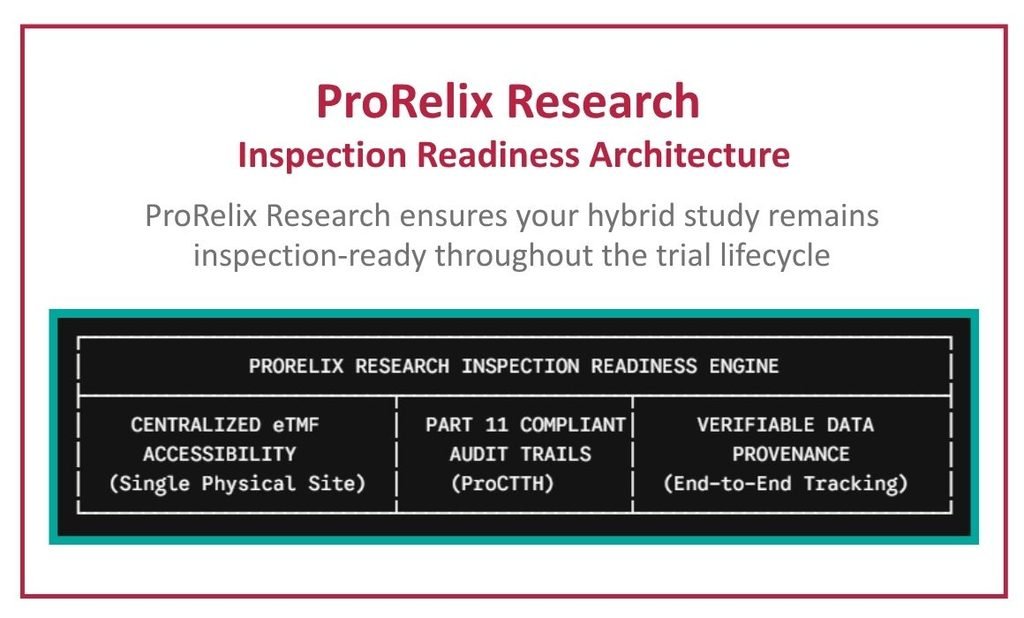
Centralized Inspection Site Infrastructure:
We support investigators in designating a compliant physical facility equipped with real-time electronic access to all trial documentation, satisfying FDA expectations for inspector interviews and record reviews.
End-to-End Data Traceability:
Data points from patient-entered outcomes to remote lab results are indexed in ProCTTH with associated device details, operator qualifications, and timestamps.
Proactive Quality Audits:
Our independent Quality Assurance (QA) team conducts ongoing mock Bioresearch Monitoring (BIMO) audits, resolving compliance issues before regulatory submissions.
Partner with ProRelix Research for Your Next Hybrid Study
Incorporating decentralized elements should streamline trial execution without increasing operational complexity or regulatory risk.
By partnering with ProRelix Research, your team gains access to experienced regulatory specialists and our proprietary ProCTTH eClinical platform. We deliver trial execution built to meet the requirements of the U.S. FDA, EMA, and international regulatory authorities.
Request Protocol Feasibility & Regulatory Review
Ensure your next trial protocol aligns with current regulatory standards.
Request a Protocol Feasibility Evaluation:
Our clinical operations team will review your protocol to identify optimal hybrid and decentralized trial elements.
- Schedule a ProCTTH Platform Demo: See how ProCTTH streamlines remote consent, patient tracking, and centralized study oversight.
- Submit an RFP: Share your study requirements with our team for a detailed operational proposal.
Submit RFP to connect with our clinical operations experts.
Additional Regulatory Resources
- FDA Final Guidance: Conducting Clinical Trials With Decentralized Elements
- FDA Guidance Snapshot & Implementation Recommendations
Frequently Asked Questions
How does the FDA define decentralized clinical trials?
The FDA defines decentralized clinical trials as studies where some or all trial-related activities take place at locations other than traditional clinical sites, using tools like telehealth, local health care providers, and direct to participant shipments.
Who holds primary responsibility for remote site oversight in a DCT?
The Principal Investigator at the physical trial site retains ultimate legal and medical responsibility for trial conduct, patient safety, and data integrity, regardless of whether local providers or mobile nursing teams assist with routine tasks.
What are the key 21 CFR Part 11 requirements for remote trial technology?
Software used for remote data collection must feature validated electronic signatures, strict access controls, secure user authentication, and automated, time stamped audit trails to ensure complete data integrity.
How is Direct to Participant investigational product shipping managed safely?
Direct to participant shipments require validated temperature controlled packaging, continuous environmental monitoring, real time chain of custody tracking, and clear protocols for handling temperature excursions and returning unused product.
How do CROs ensure FDA inspection readiness for hybrid clinical trials?
CROs maintain inspection readiness by centralizing electronic trial master files, enforcing real time data provenance via integrated platforms like ProCTTH, and conducting routine mock audits prior to regulatory submission.
