



Proven patient recruitment strategies for clinical trials in the USA, India and Europe. Practical tactics small and mid sized US biotech sponsors can use to hit enrollment goals faster.
Table of Contents
Introduction: Patient Recruitment Strategies
Patient recruitment remains one of the biggest reasons clinical trials fall behind schedule. For small and mid sized US sponsors the pressure feels even heavier. You do not have endless budgets or large internal teams to keep throwing resources at slow sites.
The good news is that patient recruitment does not have to stay a constant struggle. Sponsors who understand how patients behave differently in the USA, India and Europe and who adapt their approach accordingly consistently perform better.These are realistic strategies that actually move the needle. These are not theoretical ideas. They come from patterns seen across real trials and the practical adjustments that help lean teams succeed.
Patient Recruitment Comparison: USA vs India vs Europe
| Factor | USA | India | Europe |
| Typical Enrollment Speed | Moderate to Slow | Fast to Very Fast | Moderate |
| Strongest Channel | Digital + Physician Referral | Hospital Networks + Community | Physician Networks + Registries |
| Main Barrier | Competition & Screening Failures | Awareness & Logistics | Privacy Rules & Fragmentation |
| Cost Efficiency | High | Very High | Medium |
| Retention Challenge | High Dropout Risk | Moderate | Moderate to High |
Understand Local Patient Behavior First
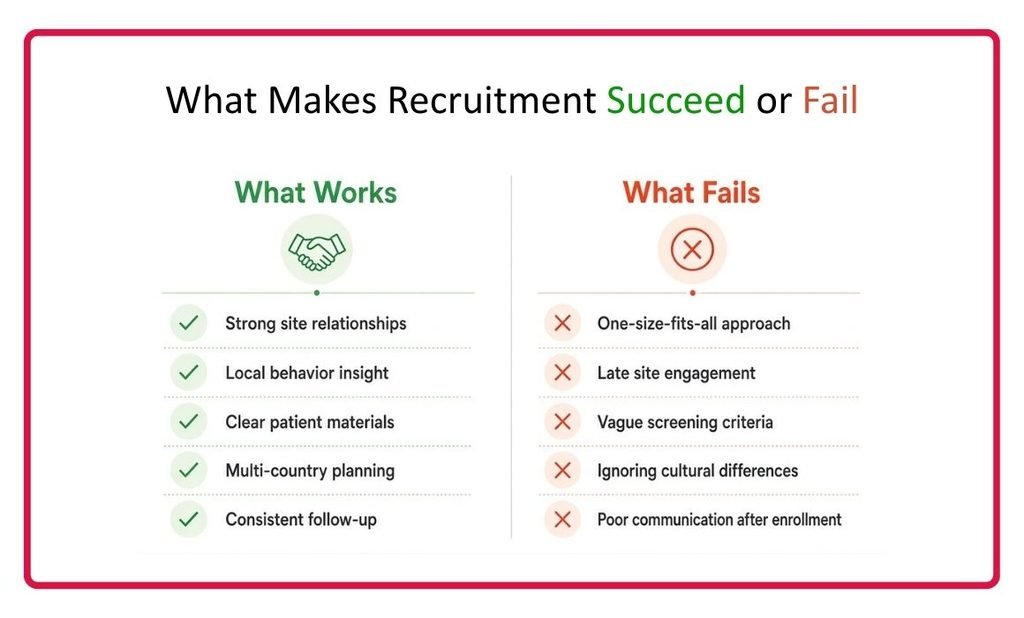
Patients in the USA often research trials online and expect clear communication about time commitment and travel. In India many patients still rely heavily on their treating doctor’s recommendation and value family involvement in decisions. Across Europe trust in the physician remains high but data privacy rules shape how you can contact potential participants.Starting with these behavioral differences prevents wasted effort. A one size fits all recruitment plan almost always underperforms.
Build Strong Site Relationships Early
The best performing sites already know their patient population. In the USA this means selecting investigators who have active databases and proven referral networks. In India high volume government and private hospitals can deliver strong numbers when the principal investigator is engaged and the study team supports them properly. In Europe relationships with key opinion leaders and specialty centers often determine whether enrollment stays consistent.
Invest time in site feasibility conversations before activation. Ask specifically about competing trials and realistic monthly enrollment estimates rather than optimistic projections.
Combine Digital and Traditional Outreach Smartly
Digital campaigns work well in the USA when messaging is clear and landing pages are simple. In India digital reach is growing quickly but hospital based awareness sessions and community health worker involvement still drive many enrollments. Europe sits somewhere in between. Targeted social media can help but physician endorsement carries more weight.The winning approach mixes both. Use digital tools to create awareness and traditional channels to convert interest into actual screening visits.
Reduce Screening Failures and Keep Patients Engaged
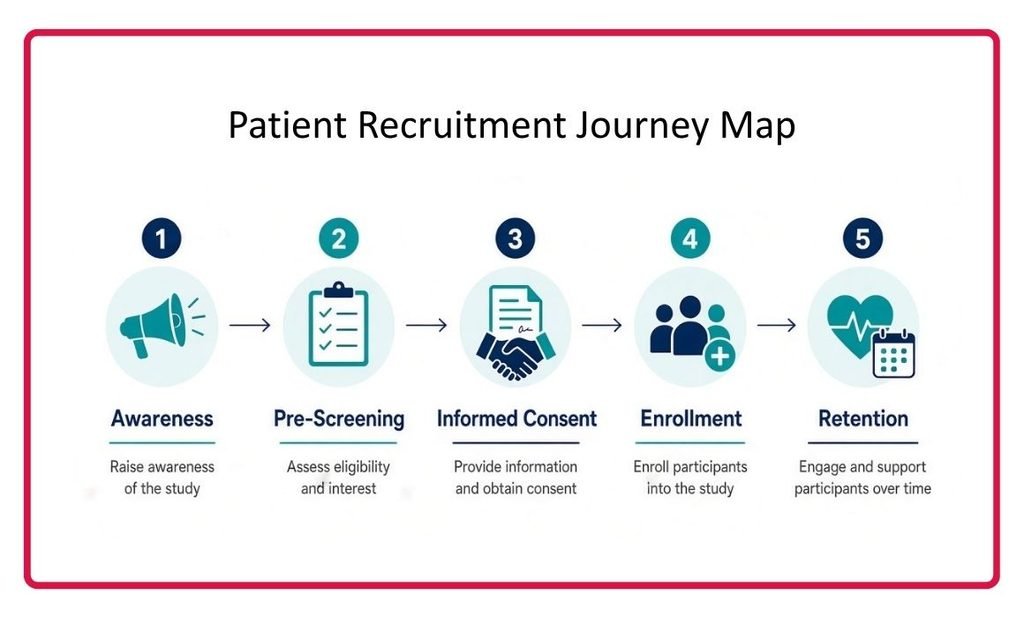
Many trials lose more patients during screening than during the actual study. Clear pre screening criteria, better education about study requirements and realistic expectations reduce screen failures. Once patients enroll, consistent communication matters more than flashy retention programs. Simple phone check ins, flexible visit windows and transparent updates about study progress help keep participants motivated across all three regions.
Plan for Multi Country Coordination from Day One
Small and mid sized sponsors often start with US sites and later add India or Europe for speed or cost reasons. The most successful teams plan the overall recruitment strategy before the first site activates. This includes aligned messaging, shared patient materials adapted for language and culture, and clear escalation paths when a region falls behind. Coordinated planning prevents the common problem of one region finishing early while another lags for months.
References
- Clinical Trials Transformation Initiative – Recruitment Project
- FDA Guidance on Enhancing Diversity in Clinical Trials
- European Medicines Agency – Clinical Trials Information
- Indian Council of Medical Research – National Ethical Guidelines
- Tufts Center for the Study of Drug Development – Enrollment Metrics Research
Expert Support for Patient Recruitment Across USA, India & Europe
Small and mid sized US sponsors often struggle with slow enrollment, high screen failure rates and limited internal bandwidth. ProRelix Research supports sponsors through patient recruitment and retention services designed around practical, country specific recruitment strategies and real operational experience across the USA, India and Europe.
Our teams work as an extension of your clinical operations group. We focus on realistic site selection and feasibility, culturally adapted outreach, participant engagement and coordinated multi country planning to support timely enrollment and effective trial execution.
With integrated clinical operations and site management support, sponsors can coordinate recruitment activities across regions while maintaining consistent operational oversight and reducing unnecessary delays.
Ready to improve your next trial’s recruitment performance?
Request a Free Recruitment Feasibility Review
FAQs
Why do many US sponsors struggle with patient recruitment even with good protocols?
High competition for the same patient pools, strict eligibility criteria and limited site bandwidth are the most common reasons. Adding well selected sites in India or Europe often improves overall enrollment speed.
Is patient recruitment faster in India than in the USA?
In many therapeutic areas yes. Higher patient volumes at experienced sites and strong physician influence often lead to faster enrollment when the study is properly supported.
Do European sites require different recruitment approaches than US sites?
Yes. Privacy regulations limit certain digital outreach methods and physician trust plays a larger role. Local language materials and registry based approaches usually perform better.
How can small biotech companies improve recruitment without large budgets?
Focus on fewer high performing sites, invest in strong site relationships, use clear patient facing materials and consider strategic multi country expansion rather than adding many low performing US sites.
When should a sponsor consider adding India or Europe to a US based trial?
When US enrollment is slower than projected, when budget pressure increases, or when the protocol allows for broader geographic inclusion without compromising data quality or regulatory strategy.
