


Need CDSCO drug approval in India? Explore approval requirements, submission steps, common challenges, and regulatory support for pharma sponsors.
Table of Contents
Planning to Launch a Drug in India? Your Regulatory Strategy Matters More Than You Think
India has become one of the world’s most attractive pharmaceutical markets, offering significant opportunities for global and domestic pharmaceutical companies. However, entering the Indian market requires more than a promising product and strong clinical data. It requires a well-planned regulatory strategy and a clear understanding of the Central Drugs Standard Control Organization (CDSCO) approval process. For pharma sponsors, delays in regulatory approval can impact product launch timelines, increase development costs, affect revenue projections, and create competitive disadvantages. A single deficiency in the submission dossier, an unexpected regulatory query, or a misunderstanding of local requirements can result in months of delays.
Many sponsors assume that obtaining drug approval in India is simply a matter of submitting documentation. In reality, successful approval requires strategic planning, thorough preparation, and continuous engagement throughout the regulatory review process.
Whether you are preparing to introduce a new chemical entity, biologic, biosimilar, vaccine, specialty pharmaceutical product, or imported drug into India, understanding the CDSCO approval pathway is essential.This guide explains the CDSCO drug approval process step by step, highlights common challenges faced by pharma sponsors, and outlines practical strategies to improve approval success.
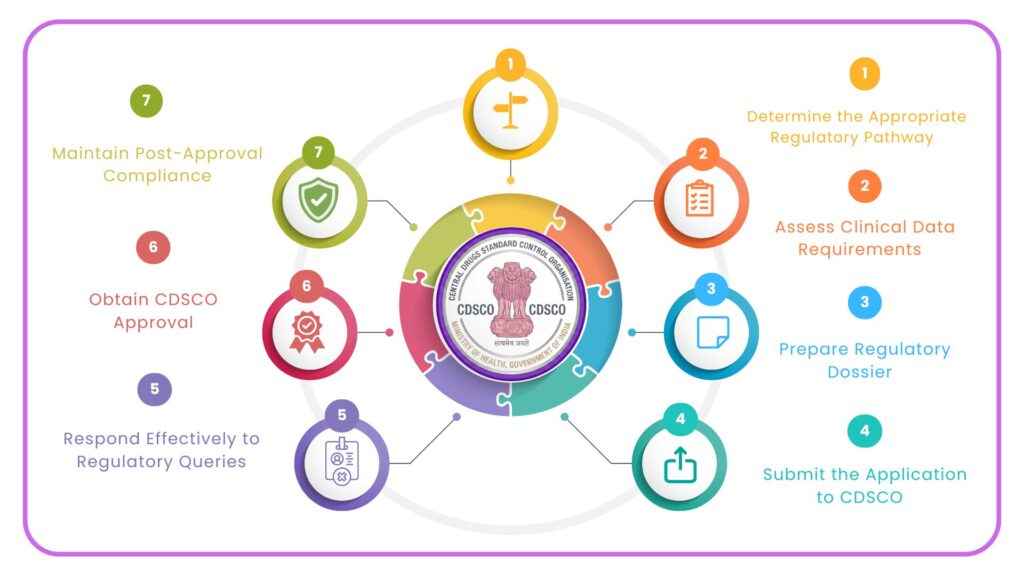
CDSCO Drug Approval Process at a Glance
| Step | Stage | Key Sponsor Activities | Typical Outcome |
| 1 | Regulatory Pathway Assessment | Determine product classification, approval pathway, and applicable CDSCO requirements | Clear regulatory strategy |
| 2 | Clinical Data Evaluation | Assess global clinical data, identify local study requirements, and address potential data gaps | Clinical development plan aligned with CDSCO expectations |
| 3 | Dossier Preparation | Compile administrative, quality, nonclinical, and clinical documentation | Submission-ready regulatory dossier |
| 4 | CDSCO Submission | Submit the application through the appropriate regulatory pathway | Application accepted for review |
| 5 | Regulatory Review | CDSCO evaluates product quality, safety, efficacy, and compliance | Regulatory queries and technical assessment |
| 6 | Query Response Management | Prepare scientifically justified responses to CDSCO questions | Faster review progression |
| 7 | Approval Decision | CDSCO completes benefit-risk assessment and final review | Marketing authorization or import approval |
| 8 | Post-Approval Compliance | Maintain pharmacovigilance, reporting, labeling, and regulatory obligations | Continued market access and compliance |
Why This Matters for Pharma Sponsors
Sponsors that invest in early regulatory planning often experience:
✓ Fewer regulatory deficiencies
✓ Reduced approval delays
✓ Improved submission quality
✓ Faster market entry
✓ Better alignment with CDSCO expectations
✓ Lower regulatory risk throughout the product lifecycle
Why CDSCO Approval Is Critical for Pharma Sponsors
The Central Drugs Standard Control Organization (CDSCO) serves as India’s national regulatory authority responsible for approving new drugs, overseeing clinical trials, regulating imports, and ensuring the safety, efficacy, and quality of pharmaceutical products.
Before any new drug can be legally marketed in India, sponsors must obtain the necessary approvals from CDSCO.For pharmaceutical companies, CDSCO approval is often a critical milestone that directly impacts:
- Product commercialization strategies
- Market entry timelines
- Investment planning
- Revenue forecasts
- Competitive positioning
- Patient access initiatives
As India’s pharmaceutical sector continues to grow, regulatory expectations have become increasingly sophisticated. Sponsors are expected to provide robust scientific evidence, comprehensive documentation, and a clear demonstration of product quality, safety, and efficacy.
Why Do CDSCO Drug Applications Get Delayed?
Before discussing the approval process, it is important to understand why many submissions experience delays. Common causes include:
Incomplete Regulatory Documentation
Missing information, inconsistent data, or poorly organized dossiers often trigger requests for additional information.
Clinical Data Deficiencies
Sponsors frequently underestimate the level of scientific justification required when relying on foreign clinical data.
CMC Documentation Gaps
Chemistry, Manufacturing, and Controls (CMC) deficiencies remain one of the most common reasons for regulatory questions.
Regulatory Strategy Misalignment
Selecting an inappropriate submission pathway can significantly extend review timelines.
Delayed Responses to CDSCO Queries
Slow or incomplete responses can stall the review process and delay approval decisions. For sponsors planning a commercial launch, every month of delay can impact market share, patient access, and return on investment. Understanding these risks early can help organizations avoid costly setbacks.
Step 1: Determine the Appropriate Regulatory Pathway
The first step in obtaining CDSCO approval is identifying the correct regulatory pathway for your product. The applicable pathway depends on several factors, including:
- Product classification
- Intended indication
- Existing marketing approvals
- Clinical development status
- Manufacturing location
Products commonly reviewed by CDSCO include:
- New Chemical Entities (NCEs)
- Biologics
- Biosimilars
- Vaccines
- Fixed-Dose Combinations (FDCs)
- Orphan Drugs
- Imported Pharmaceuticals
Each category may have different data requirements, review expectations, and approval timelines. A regulatory gap assessment at the beginning of the project can help identify potential challenges before submission activities begin.
Step 2: Assess Clinical Data Requirements
One of the most important considerations for pharma sponsors is determining whether existing clinical data will satisfy CDSCO requirements. The agency may evaluate:
- Global clinical trial data
- Multi-regional clinical trials
- Foreign regulatory approvals
- Safety profiles
- Ethnic sensitivity considerations
- Indian patient population relevance
In some situations, local clinical data may be required. Sponsors that proactively evaluate data requirements early in development are often better positioned to avoid regulatory surprises during review.
Step 3: Prepare a Submission-Ready Regulatory Dossier
The quality of your regulatory dossier can significantly influence approval timelines. A well-prepared submission should present a clear and scientifically sound story that demonstrates the product’s quality, safety, and efficacy. Typical dossier components include:
Administrative Documents
- Application forms
- Cover letters
- Authorization documents
- Power of Attorney (where applicable)
Quality Documentation
- Drug substance information
- Drug product information
- Manufacturing process descriptions
- Stability studies
- Specifications and analytical methods
Nonclinical Documentation
- Pharmacology reports
- Toxicology studies
- Safety assessments
Clinical Documentation
- Clinical study reports
- Integrated summaries
- Benefit-risk evaluations
- Safety analyses
Incomplete or inconsistent dossiers frequently result in multiple rounds of regulatory queries.
Step 4: Submit the Application to CDSCO
Once the dossier is finalized, sponsors can proceed with submission through the appropriate CDSCO channels. During the review process, regulators evaluate:
- Product quality
- Clinical efficacy
- Safety profile
- Manufacturing controls
- Risk-benefit assessment
Review timelines can vary depending on the complexity of the product and the quality of the submission package. Sponsors that submit complete, scientifically robust dossiers generally experience a smoother review process.
Step 5: Respond Effectively to Regulatory Queries
Most sponsors receive questions during the review cycle. Common areas of focus include:
- Clinical data interpretation
- Stability information
- Manufacturing controls
- Product labeling
- Risk management strategies
The quality of query responses can directly influence approval outcomes. Responses should be:
- Scientifically justified
- Data-driven
- Complete
- Consistent with the submitted information
Well-prepared responses help maintain review momentum and reduce approval delays.
Step 6: Obtain CDSCO Approval
Once CDSCO determines that the product satisfies applicable regulatory standards, approval may be granted. Depending on the product category, sponsors may receive:
- New Drug Approval
- Import Authorization
- Marketing Authorization
- Conditional Approvals
- Additional Post-Approval Requirements
Approval represents a major milestone but is not the end of regulatory responsibilities.
Step 7: Maintain Post-Approval Compliance
Successful commercialization requires ongoing regulatory compliance. Key post-approval obligations may include:
- Pharmacovigilance activities
- Adverse event reporting
- Periodic safety reporting
- Label updates
- Regulatory variations
- Inspection readiness
Sponsors that establish strong compliance systems are better positioned to maintain long-term market access.
Is Your Drug Ready for CDSCO Submission?
Before filing your application, ask the following questions:
✓ Have all regulatory requirements been evaluated?
✓ Is your clinical package aligned with CDSCO expectations?
✓ Have potential dossier gaps been identified?
✓ Is your submission scientifically and technically consistent?
✓ Is your team prepared to respond quickly to regulatory queries?
If the answer to any of these questions is no, conducting a pre-submission regulatory assessment may help reduce approval risks and improve submission readiness.
How Expert Regulatory Support Can Accelerate Approval
Many pharma sponsors partner with experienced regulatory professionals to reduce uncertainty and improve submission quality. Regulatory support can assist with:
- Regulatory strategy development
- CDSCO pathway assessment
- Gap analysis
- Dossier preparation and review
- Regulatory writing
- Submission management
- Query response support
- Post-approval compliance planning
- Early planning and expert guidance often help sponsors avoid costly delays and improve approval outcomes.
Need Support with CDSCO Drug Approval in India?
Whether you are preparing for a new drug application, planning market entry into India, or seeking to strengthen your regulatory strategy, having the right expertise can make a significant difference. Our regulatory affairs team supports pharmaceutical and biotechnology sponsors with:
- CDSCO Drug Approval Strategy
- Regulatory Gap Assessments
- Dossier Preparation and Review
- Regulatory Writing
- Submission Management
- Query Response Support
- Post-Approval Compliance
Request a Free Regulatory Assessment
Speak with our regulatory specialists to identify potential submission gaps, reduce approval risks, and support a smoother path to CDSCO approval in India.
Frequently Asked Questions (FAQs)
Approval timelines vary depending on the product type, dossier quality, and regulatory queries. Well-prepared submissions generally move through the review process more efficiently.
Yes, CDSCO may accept foreign clinical data if it is scientifically justified and relevant to the Indian population. Additional local data may be required in certain cases.
Incomplete documentation, CMC deficiencies, clinical data gaps, and delayed responses to regulatory queries are among the most common causes of approval delays.
Sponsors typically need administrative, quality, nonclinical, and clinical documentation, along with supporting regulatory and manufacturing information.
Early regulatory planning, thorough dossier preparation, gap assessments, and timely query responses can significantly improve approval readiness and reduce delays.
