



Transform outcomes with Site Selection Optimization for Multi-Regional Development using a Site selection optimization framework, leveraging advanced analytics to select top-tier sites globally.
Oncology clinical trials represent a dynamic frontier where site selection optimization directly influences the pace of innovation and the relevance of therapeutic advances. In multi-regional development programs, the careful choreography of geographic choices shapes not only enrollment timelines but also the broader applicability of findings to diverse patient populations. Real-world oncology clinical trial programs reveal how strategic site decisions turn potential obstacles into pathways for accelerated approvals and equitable access. These stories highlight the interplay between patient pools, regulatory landscapes, and operational realities across continents.
Table of Contents
The narrative often begins with ambitious protocols targeting complex cancers such as non-small cell lung cancer, diffuse large B-cell lymphoma, or cervical cancer. Sponsors face the challenge of balancing speed with representativeness. When site portfolios lean too heavily toward one region, questions arise about whether results mirror the experiences of patients in key markets like the United States. Recent regulatory discussions underscore this point, emphasizing the need for thoughtful distribution that accounts for differences in disease presentation, standard of care, and healthcare infrastructure.
Lessons from a Phase 3 Non-Small Cell Lung Cancer Trial
One compelling example unfolded in a large Phase 3 study for non-small cell lung cancer that spanned over 230 sites across 17 countries with a target of nearly 1100 patients. Early feasibility assessments identified hurdles typical of oncology programs, including seasonal slowdowns in Europe and intense site competition in the United States. The team addressed these through targeted site relationships and parallel processing.
Within three months, 49 European sites were activated despite the summer period, a traditionally slow window. Simultaneously, 28 U.S. sites came online within four months of selection. This coordinated approach demonstrated how established investigator networks and streamlined feasibility methodologies compress activation timelines while upholding quality standards.
The trial ultimately met enrollment goals more reliably, illustrating the value of proactive geographic modeling over reactive adjustments.Such outcomes stem from integrating historical performance data with real-time insights into patient density and investigator expertise. In this case, the emphasis on community and academic sites ensured broader reach without sacrificing protocol adherence. The result was a robust dataset that supported efficient regulatory reviews and highlighted the advantages of diversified portfolios in mitigating regional disruptions.
Navigating Regional Heterogeneity: The STARGLO Trial Experience
Another instructive story centers on the STARGLO trial, a confirmatory study for glofitamab in relapsed or refractory diffuse large B-cell lymphoma. The program enrolled patients across multiple regions, yet the distribution raised important considerations during FDA review. With a notable portion of participants from Asian sites and limited representation from the United States, the Oncology Drugs Advisory Committee examined differential outcomes between regions.
Although the trial achieved its primary endpoint, concerns about patient characteristics, standard-of-care variations, and generalizability led to a vote questioning applicability to the U.S. population. This case illustrates how imbalances in site allocation can complicate interpretations, even when overall efficacy signals appear strong. It reinforces the importance of upfront planning that justifies geographic choices and incorporates sufficient U.S. participants to support robust subgroup analyses.
Regulatory feedback from this and similar programs has prompted greater focus on site selection criteria that prioritize diversity and alignment with U.S. medical practice. Sponsors now evaluate not only enrollment potential but also site readiness for inspections and compatibility with local treatment landscapes. The experience underscores a key principle: multi-regional trials succeed when design anticipates regional variability rather than addressing it after data collection.
Accelerating Multinational Cervical Cancer Research
In the realm of rarer or regionally prevalent cancers, a biotechnology sponsor advanced a Phase 1/2 multinational trial for a novel intratumoral radiosensitizer in locally advanced cervical cancer. Strategic global execution enabled rapid site activation across diverse settings. The program leveraged localized expertise to navigate varying regulatory timelines and infrastructure capabilities, resulting in efficient patient recruitment and high-quality data capture. This case demonstrates how tailored site feasibility, combined with strong operational partnerships, supports complex protocols in therapeutic areas where patient pools may concentrate in specific geographies. The trial progressed smoothly, offering a model for programs seeking to balance speed with scientific rigor in multi-regional contexts.
Data-Driven Insights in Phase 3 Oncology Optimization
Additional oncology programs have benefited from advanced analytics in site selection. One pharmaceutical company applied claims data and historical metrics to identify high-performing sites with proven recruitment track records for a new oncology agent. The approach minimized screen failures and optimized resource allocation, leading to more predictable enrollment curves. These examples collectively show that optimization transcends simple site counting. It involves modeling scenarios that weigh patient access, regulatory alignment, and operational feasibility to construct resilient trial networks.
Key Metrics from Oncology Multi-Regional Site Performance
Industry benchmarks provide a clear visual lens into site optimization outcomes in oncology:
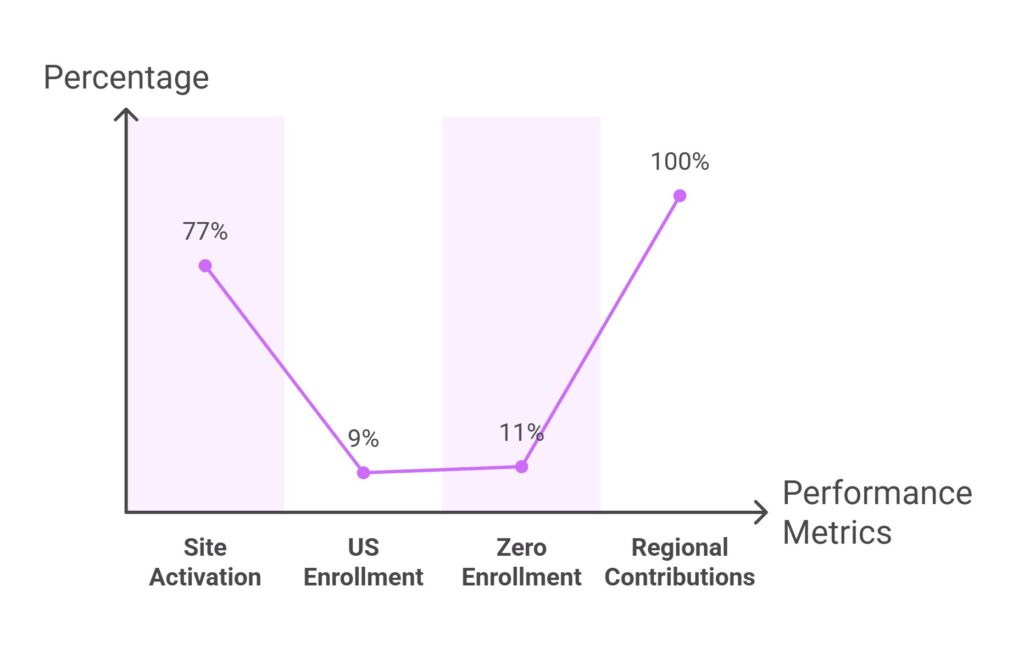
Site Activation Timelines
Strategic approaches have enabled activation of 77 sites across major regions within four months, setting benchmarks for complex programs.
Enrollment Distribution Challenges
In select trials, U.S. participation has been as low as 9 percent, prompting questions of generalizability, while others achieved more balanced allocations through deliberate planning.
Performance Outcomes
Approximately 11 percent of sites enroll zero patients across global studies, with optimized portfolios reducing this risk through data-informed selections.
Regional Contributions
Asia-Pacific and Latin American sites frequently exceed 100 percent of targets due to higher patient density, complementing mature markets for overall acceleration.
Comparative Table of Regional Considerations in Oncology Site Selection
The following table summarizes practical differences that guide portfolio construction:
| Region | Key Strengths | Notable Challenges | Optimal Application |
| North America | Advanced infrastructure, diverse populations | Higher costs, site competition | Core data for U.S. applicability |
| Europe | Harmonized processes in many countries | Variable activation in select areas | Established networks for complex protocols |
| Asia Pacific | Rapid recruitment, large patient pools | Regulatory variability | High-volume enrollment support |
| Latin America | Growing capabilities, motivated participants | Logistical considerations in remote zones | Enhancing global representation |
Such comparisons enable sponsors to build balanced configurations tailored to specific oncology indications.
Industry Relevance and Forward Momentum
These oncology case studies reveal a consistent theme: thoughtful site selection optimization transforms multi-regional development into a cohesive success narrative. Programs that integrate predictive analytics, early stakeholder engagement, and adaptive monitoring consistently achieve faster activation, better diversity, and more reliable evidence generation. As regulatory expectations evolve, with initiatives like Project Site Selector encouraging deeper dialogue on geographic strategies, the emphasis on representativeness grows stronger.
Contract research organizations with extensive global networks contribute specialized knowledge that bridges regional gaps. Their role in feasibility assessments and ongoing performance support proves instrumental for sponsors navigating the intricate landscape of cancer research. Ultimately, optimized site choices not only shorten development cycles but also ensure that new therapies reach patients worldwide with confidence in their applicability and safety.
Read More: Clinical Research Organizations: Importance, Services, Selection Process and Future.
References
- Reagan-Udall Foundation. Improving Oncology Multi-Regional Clinical Trials. https://reaganudall.org/sites/default/files/2025-11/Oncology%20Clinical%20Trials_Paper_Final_0.pdf
- U.S. Food and Drug Administration. Considerations for Generating Clinical Evidence from Oncology Multiregional Clinical Development Programs. https://www.fda.gov/media/181824/download
- Precision for Medicine. Case Study: Phase 3 NSCLC Site Relationships Streamline Feasibility. https://www.precisionformedicine.com/blog/site-relationships-streamline-feasibility-in-phase-3-nsclc-trial
- ProRelix Research. Accelerating a Multinational Cervical Cancer Trial. https://prorelixresearch.com/multinational-cervical-cancer-trial/
- PurpleLab. Optimizing Site Selection for Phase III Oncology Trials Using Data-Driven Insights. https://purplelab.com/resources/optimizing-site-selection-for-phase-iii-oncology-trials-using-data-driven-insights
- Friends of Cancer Research. Multi-Regional Clinical Trials: Addressing Standard of Care Variability. https://friendsofcancerresearch.org/publication/white-paper-multi-regional-clinical-trials-addressing-standard-of-care-variability/
FAQs
Oncology protocols frequently involve complex eligibility criteria, biomarker-driven designs, and intensive monitoring, which demand sites with specialized expertise and infrastructure. Regional differences in standard of care further complicate control arm selection and data interpretation.
Proactive planning that mandates sufficient U.S. participant allocation, combined with selection of community sites alongside academic centers, helps improve representativeness. Justification of geographic choices with supporting data on patient characteristics and healthcare systems strengthens regulatory submissions.
Predictive analytics and real-world data sources enhance feasibility by forecasting enrollment potential and identifying high-performing investigators. These tools complement traditional site engagement, leading to more accurate portfolio modeling.
Recent FDA recommendations stress conducting trials across multiple continents rather than single regions and evaluating site contributions to population diversity. Sponsors must demonstrate that selected sites support applicable and interpretable results for the intended U.S. population.
Yes, when protocols align with their capabilities, community sites expand access, improve diversity, and accelerate recruitment. Careful assessment of infrastructure needs ensures they deliver high-quality data without undue burden.
