



CDASH Design Principles Accelerating Database Build Timelines, Boost clinical trial database build speed by 40-60%.
Reduce SDTM mapping effort by up to 60% and achieve faster database lock using standardized CRFs. Essential strategies for sponsors and data managers.
In the high-stakes arena of clinical development, time truly is everything. A faster database build does not just shave days off the schedule. It can accelerate patient enrollment, speed up critical decision-making, and bring life-changing therapies to market sooner. Clinical Data Acquisition Standards Harmonization, better known as CDASH, stands out as one of the most practical tools available to achieve exactly that. By embedding smart standardization into data collection from day one, CDASH transforms lengthy, error-prone database setups into streamlined, predictable processes that deliver real results.
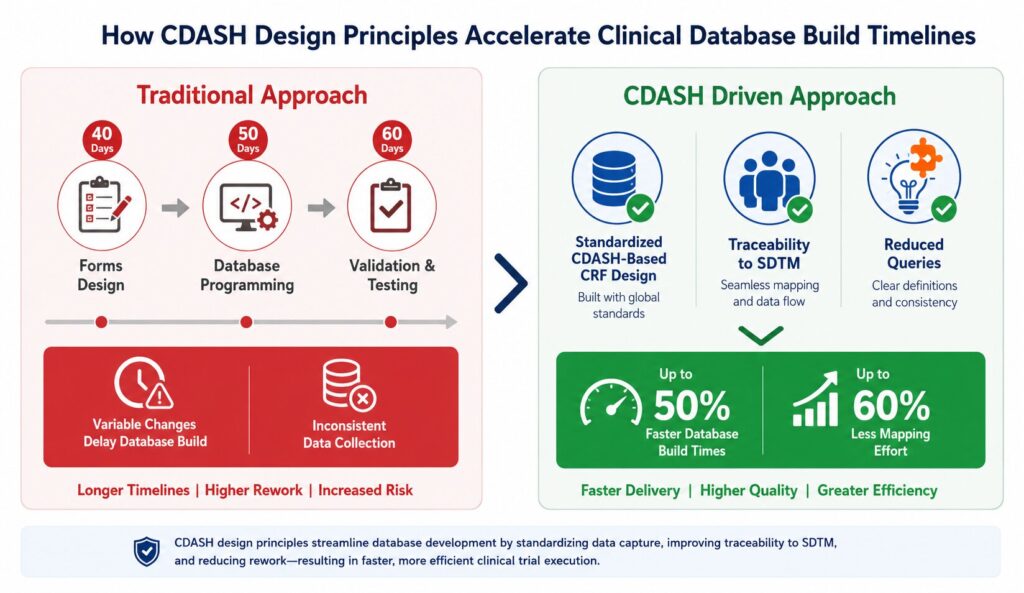
This visual perfectly illustrates the dramatic shift from traditional chaos to CDASH-powered efficiency that forward-thinking teams are embracing today.
Clinical teams know the pain all too well. Building an electronic data capture system for a new study often feels like starting from zero every single time. Custom case report forms, inconsistent variable names, repeated programming cycles, and lengthy user acceptance testing sessions can easily stretch into weeks or even months. The result? Delayed study starts, frustrated sites, and mounting costs. CDASH offers a proven way out of this cycle by providing ready-made, regulator-aligned standards that make data collection smoother and future-proof right from the protocol stage.
Why CDASH Has Become Essential in Today’s Clinical Trials
At its heart, CDASH is about collecting the right data in the right format from the beginning. Developed by the Clinical Data Interchange Standards Consortium (CDISC), it creates a natural bridge between what site staff enter on electronic forms and what statisticians and regulators need later in the process. Instead of fighting against mismatched structures during the transition to SDTM datasets, teams using CDASH principles enjoy built-in alignment that eliminates much of the heavy lifting.
This is not just theoretical. Organizations that fully adopt these standards frequently see their database build timelines drop by 40 to 60 percent. In one notable acceleration during urgent COVID-related studies, teams achieved full database readiness in as little as 11 business days compared to the more typical 30 to 60 days. Such gains come from reusing standardized domains for common areas like demographics, medical history, adverse events, and lab results, which drastically cuts down on custom development work.
The Practical Ways CDASH Compresses Timelines
Traditional database builds involve endless rounds of CRF drafting, programming tweaks, testing, and fixes. Each change risks introducing new inconsistencies that prolong the cycle. CDASH changes this by supplying clear implementation guides and best-practice templates that experienced data managers can adapt quickly rather than invent from scratch.
The principles emphasize traceability, meaning variable names and structures in collection already anticipate downstream needs. This foresight dramatically reduces mapping efforts later, with many teams reporting up to 60 percent less work when generating submission-ready datasets. Fewer mappings also mean fewer opportunities for errors, which leads to cleaner data and significantly lower query volumes during the trial.
Beyond speed, the quality improvements are substantial. Consistent data collection across studies creates libraries that can be leveraged again and again. This reuse compounds savings across an entire development program, allowing sponsors to launch multiple studies with greater confidence and predictability.
| Aspect | Traditional Approach | CDASH Approach | Observed Benefit |
| Database Build Time | 30 to 68 business days | Often under 25 days | 40-60% faster |
| SDTM Mapping Effort | High custom programming | Pre-aligned structures | Up to 60% reduction |
| Query Rates | Higher due to inconsistencies | Substantially lower | Faster cleaning cycles |
| Cross-Study Reuse | Minimal | Strong library development | Major program-level savings |
| Overall Data Quality | Variable | Highly consistent | Improved regulatory confidence |
This comparison shows why many organizations now consider CDASH a strategic advantage rather than just a technical requirement.
Core Design Principles That Make the Difference
Successful CDASH implementation revolves around a few key ideas applied thoughtfully throughout the design phase. Traceability remains central. When collection tools follow established domain conventions, the entire data flow becomes transparent and easier to validate. This principle alone saves countless hours that would otherwise go into complex transformations and reconciliations.
Teams also focus on balancing the needs of all users. Site personnel benefit from intuitive, straightforward forms that minimize entry burden. Data managers appreciate structures that support efficient cleaning. Programmers gain from designs that simplify automation and validation. By considering these perspectives early, projects avoid the costly rework that commonly inflates timelines.
Another practical principle involves collecting only what is truly necessary. CDASH encourages teams to prioritize essential fields while maintaining flexibility for protocol-specific needs. This lean approach keeps forms focused, reduces training requirements, and limits the volume of data that needs cleaning later.
Real Impact Across the Trial Lifecycle
The advantages extend well beyond the initial build. Studies using CDASH-aligned designs often reach database lock faster because initial data quality is higher. Some implementations have achieved query rate reductions approaching 98 percent in well-controlled environments. These efficiencies help teams hit ambitious targets like locking databases within four to eight weeks after the last patient visit.
For organizations managing complex global programs, integrating strong data standards with expert support becomes essential. Many successful sponsors pair their CDASH strategies with professional Clinical Data Management Services to ensure rapid database launches, high-quality outputs, and seamless regulatory compliance.
Looking ahead, the growing adoption of decentralized trials, adaptive designs, and real-world evidence only increases the value of standardization. CDASH provides a solid foundation that supports these innovations without creating new bottlenecks in data handling.
Addressing Common Implementation Hurdles
Of course, transitioning to CDASH requires commitment. Teams with long histories of custom processes may face a learning curve, and building an initial standards library takes upfront effort. The most successful organizations start with pilot studies, gather feedback, and scale gradually while investing in targeted training for data management and programming staff.
The return on this investment quickly becomes evident through faster study starts, reduced programming costs, and smoother regulatory interactions. Many companies now view CDASH not as an added requirement but as a core part of their operational excellence strategy.
Looking Forward With CDASH
As clinical development continues evolving toward greater complexity and speed, standards like CDASH will play an even bigger role. Ongoing updates from CDISC incorporate real-world feedback, ensuring the framework remains relevant for next-generation trial designs. Teams that master these principles today will be best positioned to deliver faster, higher-quality studies tomorrow.
By embracing CDASH design principles, clinical research organizations can turn database build activities from a traditional bottleneck into a genuine competitive strength.
References
- CDISC Official CDASH Standards – https://www.cdisc.org/standards/foundational/cdash
- How CDISC and CDASH Streamline Clinical Trials – https://cytel.com/perspectives/how-cdisc-and-cdash-crf-standards-streamline-clinical-trials
- CDASH Standards and Conformance Best Practices – https://www.quanticate.com/blog/cdash-standards-and-conformance
- Accelerating Clinical Trial Design and Operations – https://www.appliedclinicaltrialsonline.com/view/accelerating-clinical-trial-design-and-operations
- Standardizing Data Collection with CDASH – https://www.mednetsolutions.com/blog/standardizing-data-collection-with-cdash/
Frequently Asked Questions
CDASH specifically targets the beginning of the data journey by standardizing collection forms and variables. This early standardization creates natural alignment with later stages like SDTM, saving significant time and effort compared to standards that only address downstream processes.
Many teams report reductions of 40 to 60 percent or more. In accelerated scenarios, full database readiness has been achieved in under two weeks, though results depend on study complexity and organizational maturity.
Yes. The reusable templates and reduced custom work make it especially valuable for teams with limited resources. It helps control costs while improving data quality and regulatory compliance.
Initial training and library development are the main hurdles. However, these are one-time investments that pay dividends across multiple studies through greater efficiency and consistency.
By providing consistent structures regardless of data source, CDASH makes integration of electronic health records, wearables, and direct site entry much smoother. This flexibility helps maintain speed and quality even in complex trial designs.
