



CSR Writing Frameworks Meeting CTD Module 5 Requirements helps improve regulatory submission quality, data traceability, and review readiness.
Clinical Study Reports That Support Faster Regulatory Review and Submission Readiness
Clinical Study Reports are among the most scrutinized documents in a regulatory submission. They serve as the primary source of evidence demonstrating how a clinical trial was conducted, analyzed, and interpreted. Yet many organizations continue to face challenges with CSR quality, consistency, traceability, and alignment with Common Technical Document (CTD) requirements.
As global regulatory agencies continue to expect greater transparency and data integrity, a well-structured CSR is no longer just a regulatory document. It has become a strategic asset that directly influences submission quality, review efficiency, and regulatory confidence.
Organizations that adopt standardized CSR writing frameworks are better positioned to reduce review cycles, maintain consistency across studies, and support successful CTD Module 5 submissions.
Understanding the Role of Clinical Study Reports in CTD Module 5
CTD Module 5 contains the complete clinical study documentation that supports the safety and efficacy of an investigational product. Within this module, the Clinical Study Report serves as the central narrative that integrates protocol execution, patient data, statistical analyses, efficacy findings, and safety outcomes.
Regulatory reviewers rely heavily on CSRs to understand:
- Study objectives and design
- Patient population characteristics
- Protocol compliance
- Statistical methodologies
- Efficacy outcomes
- Safety evaluations
- Benefit risk considerations
Any inconsistency between CSR content and supporting datasets can trigger additional questions, review delays, or requests for clarification.
CSR Development Framework for CTD Module 5
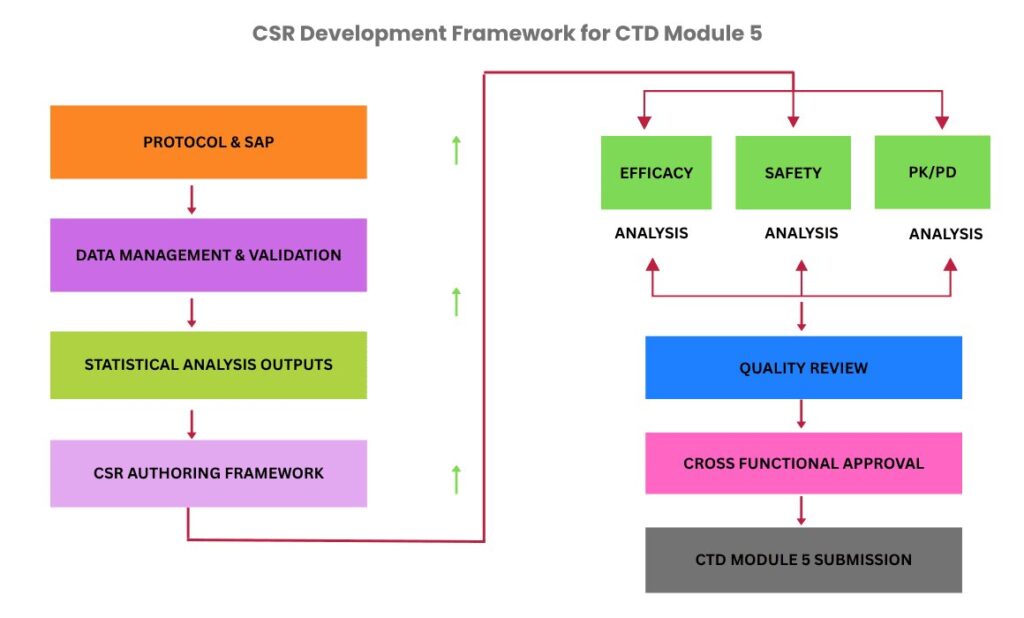
A structured workflow helps maintain traceability from source data through final regulatory submission.
Why Traditional CSR Approaches Often Create Submission Risks
Many CSR projects are still managed using fragmented processes involving multiple document versions, disconnected teams, and manual content reconciliation.
Common challenges include:
Inconsistent Data Interpretation
Medical writing teams may interpret statistical outputs differently from biostatistics teams, leading to discrepancies.
Delayed Review Cycles
Poor document structure often results in repeated reviews and extensive revisions.
Traceability Gaps
Regulatory reviewers increasingly expect clear alignment between study protocols, datasets, statistical outputs, and narrative conclusions.
Lack of Standardization
Organizations managing multiple studies frequently encounter variations in report structure and presentation style.
Core Elements of an Effective CSR Writing Framework
A modern CSR framework should combine regulatory compliance, scientific accuracy, and operational efficiency.
1. Protocol Driven Content Development
The CSR should be built around predefined study objectives and endpoints rather than retrospective interpretation.
This approach helps maintain consistency between:
- Protocol
- Statistical Analysis Plan
- CSR conclusions
- CTD submission summaries
2. Data Traceability Integration
Every efficacy and safety conclusion should be traceable back to validated datasets and statistical outputs.
Strong traceability reduces regulatory queries and supports data credibility.
3. Structured Authoring Templates
Standardized templates create consistency across studies and therapeutic areas.
Benefits include:
- Faster document development
- Reduced formatting effort
- Improved reviewer experience
- Better regulatory compliance
4. Cross Functional Collaboration
Successful CSR development requires coordination among:
| Function | Contribution |
| Medical Writing | Narrative development |
| Biostatistics | Statistical interpretation |
| Clinical Operations | Study conduct details |
| Pharmacovigilance | Safety analysis |
| Regulatory Affairs | Submission alignment |
| Clinical Development | Medical oversight |
Essential CSR Sections Required for CTD Module 5
The structure recommended by ICH E3 remains the foundation for CSR preparation.
| CSR Section | Regulatory Purpose |
| Synopsis | High level study overview |
| Ethics Information | Patient protection documentation |
| Study Objectives | Scientific rationale |
| Investigational Plan | Trial design details |
| Study Population | Subject accountability |
| Efficacy Evaluation | Clinical benefit assessment |
| Safety Evaluation | Risk assessment |
| Discussion & Conclusions | Integrated interpretation |
| Appendices | Supporting evidence |
A well-developed CSR should present a logical story of the study while maintaining complete scientific objectivity.
How Structured CSR Frameworks Improve Regulatory Readiness
Organizations adopting standardized CSR methodologies frequently experience measurable improvements.
Improved Consistency Across Programs
Standardized frameworks create uniformity across multiple studies, indications, and development phases.
Faster Review Turnaround
Clear structure reduces reviewer effort and shortens internal approval timelines.
Reduced Regulatory Queries
Traceable and transparent reporting helps reviewers locate information efficiently.
Better Submission Quality
High quality CSRs contribute to stronger integrated summaries and overall CTD completeness.
Key Quality Checks Before Finalizing a CSR
Before submission, teams should evaluate whether the report answers the following questions:
Study Design
- Are objectives consistent with the protocol?
- Are amendments adequately documented?
Statistical Reporting
- Are analyses aligned with the SAP?
- Are datasets accurately represented?
Safety Reporting
- Are adverse events fully summarized?
- Are safety conclusions supported by data?
Regulatory Consistency
- Is the CSR aligned with CTD Module 5 requirements?
- Are cross references accurate and complete?
A structured quality review process can significantly reduce submission risk.
Emerging Trends in CSR Development
The future of CSR authoring is increasingly influenced by technology and data integration.
Automation Assisted Authoring
Template driven content generation is helping teams reduce manual effort while maintaining consistency.
Data Linked Reporting
Direct integration between statistical outputs and report content is improving traceability.
Global Submission Harmonization
Organizations are adopting unified CSR frameworks to support simultaneous submissions across multiple regulatory regions.
Enhanced Quality Governance
Risk based quality review models are becoming increasingly common for complex development programs.
Strategic Considerations for Sponsors
A CSR is often viewed as the final deliverable of a clinical study. In reality, it serves as the bridge between clinical development and regulatory approval.
Organizations that invest in structured CSR writing frameworks gain advantages that extend beyond document preparation. They improve submission readiness, strengthen regulatory confidence, and support efficient review processes.
As regulatory expectations continue to evolve, companies should evaluate whether their current CSR development practices provide the consistency, traceability, and scientific rigor required for successful CTD Module 5 submissions.
The most effective CSR frameworks combine regulatory expertise, scientific understanding, operational efficiency, and quality oversight to create reports that withstand regulatory scrutiny while clearly communicating the clinical value of a therapeutic product.
Many organizations partner with a regulatory consulting firm to establish standardized CSR authoring frameworks, improve document quality, and align submissions with evolving global regulatory expectations. Such partnerships can help reduce review cycles, strengthen traceability, and support successful CTD Module 5 submissions.
Read More: CDISC Standards for Biostatistics and Clinical Data Management
References
- International Council for Harmonisation (ICH). E3 Structure and Content of Clinical Study Reports. Available at:
ICH E3 Guideline - International Council for Harmonisation (ICH). M4 Common Technical Document (CTD). Available at:
ICH M4 Common Technical Document Guideline - International Council for Harmonisation (ICH). E6(R3) Good Clinical Practice Guideline. Available at:
ICH E6(R3) Good Clinical Practice Guideline - International Council for Harmonisation (ICH). E8(R1) General Considerations for Clinical Studies. Available at:
ICH E8(R1) General Considerations for Clinical Studies - U.S. Food and Drug Administration (FDA). Electronic Common Technical Document (eCTD). Available at: FDA eCTD Guidance and Resources
- European Medicines Agency (EMA). Clinical Data Publication Policy. Available at: EMA Clinical Data Publication Policy
- International Council for Harmonisation (ICH). Official ICH Guidelines Repository. Available at:
ICH Guidelines Library
Frequently Asked Questions
What is the purpose of a Clinical Study Report in CTD Module 5?
A Clinical Study Report provides detailed documentation of a clinical trial’s design, conduct, analysis, efficacy results, and safety outcomes for regulatory review.
Which guideline governs CSR preparation?
The primary guideline is the ICH E3 Guideline on Structure and Content of Clinical Study Reports.
Why is traceability important in CSR writing?
Traceability helps regulators verify that conclusions are supported by validated clinical and statistical data.
What are the most common CSR quality issues?
Common issues include inconsistent data reporting, missing explanations, protocol deviations, and poor alignment with statistical outputs.
How can standardized CSR frameworks improve submissions?
Standardized frameworks improve consistency, reduce review cycles, enhance compliance, and support CTD Module 5 readiness.
