



Explore the operational complexity of modern oncology clinical trials including precision medicine, patient recruitment, trial design, and global clinical operations.
Table of Contents
Oncology research has entered a new era. Advances in molecular biology, precision medicine, and targeted therapies are rapidly transforming how cancer treatments are developed. While these innovations hold tremendous promise for patients, they also introduce a new level of complexity in clinical development.
Modern oncology clinical trials are no longer simple investigations of a single drug in a broad patient population. Instead, they involve biomarker driven patient selection, adaptive trial designs, complex regulatory requirements, global site networks, and extensive safety monitoring. For sponsors and clinical research teams, successfully navigating this environment requires careful planning, specialized expertise, and operational discipline.
Across the industry, organizations involved in oncology research continue to refine strategies that address these operational challenges while ensuring that promising therapies move efficiently through the clinical development pathway.
The Increasing Complexity of Oncology Clinical Development
Over the past decade, oncology drug development has evolved significantly. Traditional chemotherapy trials often relied on large patient populations and straightforward endpoints. Today, clinical development programs frequently focus on highly specific molecular targets, requiring investigators to identify patients with particular genetic or biomarker profiles.
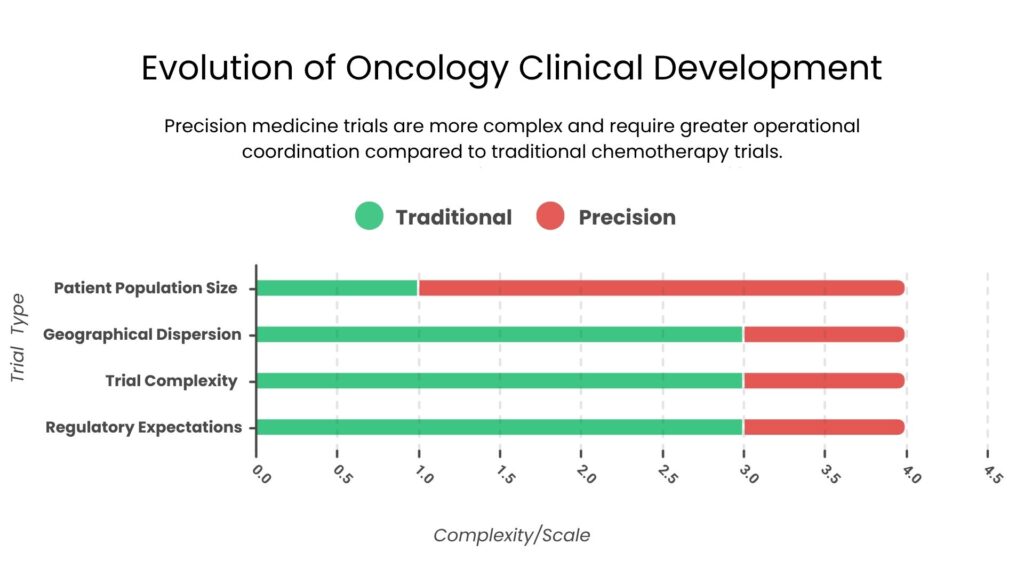
This shift toward precision medicine has dramatically improved the potential effectiveness of new therapies. However, it also makes clinical trial execution far more complex.
Modern oncology clinical development has evolved significantly over the past decade. The transition from traditional chemotherapy research to precision medicine has introduced new operational requirements and scientific considerations.
The table below highlights how oncology trials have transformed in recent years.
| Aspect | Traditional Oncology Trials | Modern Precision Oncology Trials |
| Patient Selection | Broad patient populations based on tumor type | Highly specific populations defined by biomarkers or genetic mutations |
| Trial Design | Standard randomized controlled trials | Basket trials, umbrella trials, and adaptive designs |
| Recruitment Strategy | Site based patient enrollment | Biomarker screening and precision patient identification |
| Data Collection | Clinical outcomes and safety data | Genomic data, biomarker analysis, imaging, and survival endpoints |
| Operational Complexity | Moderate operational requirements | Highly complex global coordination and specialized expertise |
Patient populations may be smaller and geographically dispersed. Trial protocols may include multiple treatment arms or adaptive design features. Regulatory expectations have increased as therapies become more sophisticated. As a result, oncology trials demand a level of operational coordination that extends far beyond conventional clinical research models.
Global clinical research leaders such as IQVIA, Parexel, ProRelix Research, ICON PLC and Labcorp Drug Development have highlighted how integrated clinical development strategies are essential to managing this complexity effectively.
Strategic Trial Design in Precision Oncology
One of the most critical steps in any oncology development program is trial design. Precision medicine approaches require carefully defined inclusion criteria based on biomarkers, genetic mutations, or tumor characteristics. Identifying the right patient population is essential to demonstrating treatment effectiveness.
Modern oncology studies increasingly use innovative trial models such as basket trials, umbrella trials, and adaptive trial designs. These approaches allow researchers to evaluate multiple therapies or patient subgroups within a single study framework.
While these models can significantly accelerate drug development, they also require advanced statistical planning, specialized operational infrastructure, and close collaboration among clinical investigators, statisticians, and regulatory experts.
Ensuring that trial designs align with regulatory expectations while remaining scientifically robust is a critical step in reducing development risk and maintaining study efficiency.
Global Site Selection and Investigator Expertise
Site selection plays a pivotal role in the success of oncology clinical trials. Investigators must have the clinical expertise, patient access, and research infrastructure required to manage complex oncology protocols.
Unlike trials in broader therapeutic areas, oncology studies often require specialized diagnostic capabilities such as genomic testing, advanced imaging technologies, and biomarker analysis. Selecting sites that can support these requirements is essential for maintaining data quality and protocol adherence.
High performing oncology research sites also contribute to faster patient enrollment and more consistent study execution. Experienced investigators are familiar with complex oncology protocols and understand the importance of accurate safety reporting, patient monitoring, and regulatory compliance.
Careful feasibility assessments and strong investigator relationships remain key factors in building successful global oncology trial networks.
Patient Recruitment in Precision Medicine Trials
Patient recruitment remains one of the most significant operational challenges in oncology clinical research. Precision oncology studies often require patients to meet specific molecular or biomarker criteria, which can significantly reduce the eligible patient population.
In addition, many oncology trials compete for the same patient populations across multiple research sites. Patients may also face logistical barriers such as travel requirements or limited awareness of available trials.
To address these challenges, clinical research teams increasingly rely on data driven recruitment strategies, patient registries, digital outreach initiatives, and collaboration with cancer treatment centers.
Early identification of eligible patients through molecular screening programs can also improve enrollment efficiency and help ensure that trials remain on schedule.
Ensuring Data Quality and Scientific Integrity
High quality data is the foundation of regulatory approval. Oncology trials generate large volumes of complex clinical and laboratory data, including imaging results, biomarker analyses, genomic data, and long term survival outcomes.
Managing this information requires robust clinical data management systems and well defined quality control processes.
Clinical data teams are responsible for ensuring that data is collected accurately, validated consistently, and analyzed according to predefined statistical methodologies. Advanced data analytics and centralized monitoring approaches are increasingly used to identify trends, detect anomalies, and maintain the overall integrity of the clinical dataset.
Maintaining rigorous data governance throughout the study lifecycle is essential to ensuring that trial outcomes withstand regulatory scrutiny.
Continuous Safety Monitoring in Oncology Studies
Patient safety remains the highest priority in any clinical trial, particularly in oncology studies where investigational therapies may have significant toxicity profiles.
Medical monitoring teams play a critical role in reviewing patient safety data, assessing adverse events, and identifying potential safety signals throughout the study. Investigators, safety physicians, and pharmacovigilance experts work together to evaluate emerging data and ensure that patient protection remains central to the research process.
Timely safety reporting and close collaboration between clinical teams and regulatory authorities are essential for maintaining compliance and ensuring the ethical conduct of oncology research.
Coordinating Complex Clinical Trial Operations
The operational demands of oncology trials require careful coordination across multiple stakeholders. Clinical investigators, site coordinators, laboratory partners, regulatory specialists, statisticians, and project management teams must work together to ensure that the study progresses according to plan.
Effective project management provides the framework for maintaining alignment across these diverse teams. Clear communication, well defined timelines, proactive risk management, and continuous performance monitoring all contribute to efficient trial execution.
As oncology development programs grow increasingly global, the ability to coordinate research activities across multiple regions and healthcare systems has become a critical component of successful clinical trial operations.
The Future of Oncology Clinical Trials
The future of oncology research will likely involve even greater levels of scientific and operational sophistication. Emerging treatment approaches such as cell and gene therapies, immunotherapies, and personalized medicine platforms are reshaping how clinical trials are designed and conducted.
Digital health technologies, real world data sources, and decentralized trial elements are also beginning to influence oncology research models. These innovations may improve patient access to trials, enhance data collection, and support more flexible study designs.
At the same time, the core principles of successful clinical development remain unchanged. Strong scientific rationale, careful operational planning, experienced investigators, and rigorous data management will continue to serve as the foundation of high quality oncology research. As the oncology landscape continues to evolve, organizations involved in clinical development must remain adaptable, collaborative, and committed to advancing therapies that improve outcomes for patients around the world.
Read More: The Promise of Clinical Trials in Advancing Solid Tumour Cancer Treatments
FAQs:
Why are oncology clinical trials complex?
Oncology clinical trials are complex because they involve biomarker based patient selection, precision medicine approaches, advanced trial designs, and strict regulatory requirements. These factors require specialized clinical expertise, global coordination, and sophisticated data management to ensure successful study execution.
What are the biggest challenges in oncology clinical trials?
The biggest challenges include patient recruitment, biomarker testing, complex trial protocols, regulatory compliance, and managing global research sites. Precision medicine has also reduced eligible patient populations, making enrollment and operational coordination more difficult.
How does precision medicine affect oncology clinical trials?
Precision medicine requires identifying patients based on genetic or molecular biomarkers. This leads to smaller, more targeted patient populations and requires innovative trial designs such as basket trials and umbrella trials to evaluate therapies effectively.
Why is patient recruitment difficult in oncology trials?
Patient recruitment is difficult because many oncology trials require patients with specific genetic mutations or biomarkers. These strict eligibility criteria reduce the number of qualified participants and increase competition among clinical trials.
What is the role of data management in oncology clinical trials?
Data management ensures accurate collection, validation, and analysis of clinical trial data. Oncology trials generate complex datasets such as genomic data, imaging results, and biomarker information, which must be carefully managed for regulatory approval.
