



Streamline your clinical trial infrastructure. Explore the top 10 US clinical data management providers of 2026 evaluated by technology and compliance.
Table of Contents
Why Clinical Data Management Matters More Than Ever
Clinical trials generate enormous volumes of information. Patient records, laboratory results, imaging files, safety reports, wearable device data, and protocol documentation all need to be collected, validated, and organized with precision. If that process breaks down, even a scientifically promising study can face delays, compliance concerns, or unreliable outcomes. That is why clinical data management has become one of the most important operational functions in modern research.
Sponsors today are no longer choosing CDM providers based solely on company size. They are looking for organizations that can manage complex data environments, adapt to decentralized trial models, maintain regulatory readiness, and support faster decision making without compromising quality.
This guide highlights the notable top 10 clinical data management companies in the United States. The list includes global CROs, technology-focused platforms, and specialized providers helping sponsors manage increasingly complex clinical studies. Rather than relying on revenue rankings alone, this article focuses on practical strengths such as operational reliability, technology integration, therapeutic expertise, and adaptability across different trial models.
Clinical data management sits at the center of every clinical study. Its purpose is straightforward: ensure that trial data is accurate, traceable, consistent, and suitable for regulatory review.
In practice, however, the process is highly complex. Modern studies often involve dozens of sites operating across multiple countries while generating data from electronic records, laboratory systems, remote monitoring devices, and patient-reported outcomes. Managing these datasets requires structured workflows, strong oversight, and systems capable of handling constant data flow without creating inconsistencies.
Poor data management can quietly affect an entire study. Delayed query resolution, inconsistent site reporting, or fragmented systems may not seem serious initially, but they often create significant problems during database lock and submission preparation. Strong CDM teams help sponsors reduce those risks early instead of correcting problems later under regulatory pressure.
Top 10 Clinical Data Management Providers
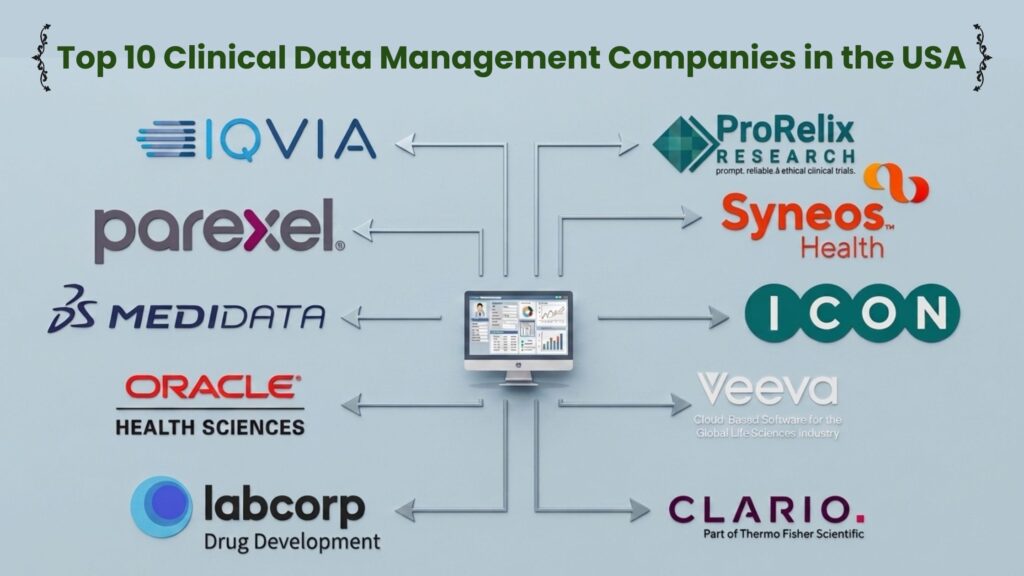
1. IQVIA
IQVIA remains one of the most influential organizations in clinical research and healthcare analytics. The company combines global CRO operations with advanced analytics, real world evidence capabilities, and AI-supported technologies. Its scale makes it particularly valuable for multinational studies involving large patient populations and complex operational oversight. Sponsors frequently choose IQVIA when they need centralized infrastructure capable of supporting global execution without relying on fragmented vendors.
| Focus Attribute | Profile Details |
| Best For | Large multinational Phase II and Phase III studies. |
| Key Strength | Integrated analytics combined with extensive global operational infrastructure. |
| Core Technology | AI-supported data engines and unified global databases. |
2. Parexel
Parexel has built a strong reputation around regulatory discipline and operational consistency. The company is widely recognized in therapeutic areas where compliance expectations are especially high, including oncology and rare diseases. Rather than focusing heavily on marketing-driven technology messaging, Parexel emphasizes execution quality and structured workflows. That approach appeals to sponsors managing studies where regulatory precision matters as much as operational speed.
| Focus Attribute | Profile Details |
| Best For | Regulatory-sensitive studies and complex therapeutic programs. |
| Key Strength | Strong inspection readiness and global submission support. |
| Therapeutic Niche | Oncology, rare diseases, and high-scrutiny pathways. |
3. Medidata
Medidata plays a major role in the infrastructure powering modern clinical trials. Its cloud-based platforms support electronic data capture, decentralized trial operations, patient monitoring, and analytics. The company became increasingly important as hybrid and decentralized studies expanded across the industry. Sponsors needed systems capable of handling patient data from multiple digital sources while maintaining centralized oversight. Unlike traditional CRO-driven workflows, Medidata focuses heavily on technology-first clinical ecosystems.
| Focus Attribute | Profile Details |
| Best For | Sponsors modernizing legacy trial systems. |
| Key Strength | Advanced decentralized trial infrastructure. |
| Core Technology | Cloud-based clinical trial ecosystem and patient-facing apps. |
4. Oracle Health Sciences
Oracle Health Sciences continues to maintain a strong presence in enterprise clinical research environments. Many large pharmaceutical companies rely on Oracle systems because of their scalability, security architecture, and compatibility with broader operational infrastructure. The company performs especially well in multinational studies requiring centralized oversight across multiple regions and operational teams.
| Focus Attribute | Profile Details |
| Best For | Enterprise-level pharmaceutical organizations. |
| Key Strength | Scalable infrastructure for global study management. |
| Core Technology | High-security database architecture and enterprise software integrations. |
5. Labcorp Drug Development
Labcorp combines clinical development services with one of the largest laboratory networks in healthcare. This integration allows laboratory and clinical datasets to move more efficiently between systems and operational teams. That advantage becomes particularly valuable in biomarker-driven studies and precision medicine programs where laboratory data directly influences study outcomes.
| Focus Attribute | Profile Details |
| Best For | Data-heavy precision medicine studies. |
| Key Strength | Strong laboratory and clinical workflow integration. |
| Data Specialty | Companion diagnostics, biomarker data, and safety labs. |
6. ProRelix Research
ProRelix Research has gained attention among sponsors looking for more flexible and responsive operational support models. The company provides clinical data management, pharmacovigilance, and biometrics services while maintaining a collaborative working structure. Unlike enterprise CROs built for massive global programs, ProRelix appeals more to biotech companies and mid-sized sponsors seeking faster communication and closer operational involvement. For lean clinical programs operating under aggressive timelines, that responsiveness can become a meaningful operational advantage.
| Focus Attribute | Profile Details |
| Best For | Emerging biotech companies and lean study teams. |
| Key Strength | Flexible execution with direct sponsor collaboration. |
| Service Scope | Full-service biometrics, safety monitoring, and responsive data management. |
7. Syneos Health
Syneos Health positions itself as a technology-enabled development organization with strong operational flexibility. Its clinical data management services are integrated with broader development and commercialization workflows. The company has invested heavily in decentralized and hybrid trial infrastructure as remote patient participation becomes increasingly common.
| Focus Attribute | Profile Details |
| Best For | Hybrid and decentralized clinical programs. |
| Key Strength | Integrated development and commercialization support. |
| Operational Model | “Lab-to-Life” end-to-end commercial pipeline integration. |
8. ICON plc
ICON supports clinical programs across multiple therapeutic areas and geographic regions. Its data management capabilities are particularly strong in large multicenter studies requiring coordinated oversight and standardized reporting practices. The company also benefits from strong biometrics and analytics operations, helping sponsors manage increasing data complexity more efficiently.
| Focus Attribute | Profile Details |
| Best For | Large international clinical studies. |
| Key Strength | Strong biometrics and operational scale. |
| Reporting Focus | Standardized multi-center data metrics and global reporting templates. |
9. Veeva Systems
Veeva has become one of the most influential software providers in life sciences. Its Vault platform is widely used across clinical operations, quality systems, and regulatory workflows. Sponsors often adopt Veeva when replacing fragmented legacy systems with more centralized cloud-based infrastructure.
| Focus Attribute | Profile Details |
| Best For | Organizations modernizing operational workflows. |
| Key Strength | Unified cloud-based clinical infrastructure. |
| Core Technology | Veeva Vault ecosystem spanning clinical, regulatory, and quality sectors. |
10. Clario
Clario specializes in endpoint data collection and decentralized trial technologies. Its systems support imaging, cardiac monitoring, wearable device integration, and electronic patient-reported outcomes. As remote participation becomes more common, endpoint technology providers like Clario are becoming increasingly important within clinical research operations.
| Focus Attribute | Profile Details |
| Best For | Remote monitoring and wearable-driven studies. |
| Key Strength | Advanced endpoint and digital health data capture. |
| Data Specialty | Core lab imaging, ECG/cardiac monitoring, and eCOA data streams. |
What to Look for When Choosing a Clinical Data Management Company
Many sponsors initially compare vendors based on pricing or company size. In reality, the more important question is whether the provider can realistically support the operational demands of the study itself.
- Regulatory preparedness should always be one of the first evaluation points. A company may have sophisticated software platforms, but weak documentation practices or inconsistent audit trails can become serious liabilities during inspections.
- Technology compatibility is equally important. Clinical trials now rely on interconnected systems involving EDC platforms, safety databases, laboratory integrations, wearable devices, and remote patient monitoring tools. A provider that struggles to integrate data efficiently can create operational bottlenecks throughout the study lifecycle.
- Therapeutic experience also matters more than many sponsors expect. Oncology studies, cardiovascular trials, rare disease programs, and medical device studies each introduce different data management challenges. Providers with direct experience in a therapeutic area are often better equipped to anticipate operational issues before they escalate.
- Communication style is another factor that significantly affects day-to-day execution. Some sponsors prefer enterprise-level structure with extensive global resources. Others prioritize faster communication, flexibility, and direct collaboration with operational teams. The strongest partnerships usually come from choosing a provider whose working style aligns with the sponsor’s internal processes and study complexity.
Why Smaller Sponsors Are Reconsidering Large CRO Models
Large CROs remain essential for many multinational clinical programs, but smaller sponsors are increasingly reassessing whether enterprise-scale operations always provide the best fit for every study.
One common challenge involves communication speed. Large organizations often operate through multiple management layers, which can slow decision making and reduce direct visibility into operational issues. As a result, many emerging biotech companies are exploring specialized providers that offer more flexibility and closer collaboration. Mid-sized organizations can often adapt more quickly to protocol changes, evolving sponsor requirements, and compressed development timelines.
This shift does not mean large CROs are losing relevance. Instead, sponsors are becoming more selective about choosing providers whose operational structure actually matches the scale and complexity of the study.
Common Problems Sponsors Face With Poor Clinical Data Management
When clinical data management is handled poorly, the consequences often emerge gradually before becoming major operational setbacks.
- Delayed query resolution: Unresolved discrepancies can slow database lock activities, delay statistical analysis, and create unnecessary pressure during submission preparation.
- Inconsistent data across study sites: Multicenter trials involve numerous investigators and coordinators working across different systems and processes. Without strong standardization, inconsistencies can quickly accumulate.
- Fragmented technology infrastructure: When EDC systems, safety databases, laboratory platforms, and monitoring tools fail to integrate smoothly, reconciliation problems become far more difficult to manage.
- Regulatory risk: Incomplete audit trails, inconsistent documentation, or unresolved data discrepancies can weaken confidence in the study itself even when the underlying science is strong.
Strong clinical data management helps sponsors prevent these issues before they affect timelines or regulatory outcomes.
Where Clinical Data Management Is Heading
Clinical data management is evolving rapidly as studies become more digital and decentralized. Artificial intelligence is increasingly being used to identify inconsistencies, prioritize query resolution, and reduce manual review workloads.
Remote patient monitoring technologies are generating continuous streams of patient data that traditional operational models were not originally designed to manage. At the same time, regulators are expecting stronger traceability, cleaner audit documentation, and better integration across clinical systems. The companies best positioned for the future will likely be those capable of combining regulatory discipline with adaptable technology infrastructure and practical operational execution.
Final Thoughts
Clinical data management has become one of the defining operational pillars of modern drug development. Sponsors are no longer looking only for vendors capable of managing databases. They are searching for partners that can support complex global studies, adapt to evolving trial models, and maintain regulatory confidence throughout development.
The companies listed here represent a wide range of operational approaches. Some provide enterprise-scale global infrastructure, while others focus on flexibility, specialized expertise, or closer sponsor collaboration. The right choice ultimately depends on the complexity of the study, therapeutic focus, operational timeline, and communication style that best fits the sponsor’s internal team.
In an industry where data quality directly influences regulatory outcomes, choosing the right clinical data management partner has become far more than an operational decision. It is now a strategic one.
Choose enterprise CROs like IQVIA or Parexel for large-scale, multi-region logistical execution. For lean biotech teams needing direct collaboration, faster communication, and rapid adjustments to protocol changes, specialized providers like ProRelix Research offer a more flexible operational model.
Technology-first ecosystems like Medidata and Veeva Systems provide the unified, cloud-based software and electronic data capture architecture to house information. Traditional full-service CROs provide the human infrastructure, site monitoring, and regulatory workflows to manage the day-to-day data lifecycle.
Instead of batch-processing data weeks after site visits, providers like Syneos Health, Medidata, and Clario use decentralized trial infrastructure. This continuously integrates multi-channel data streams from wearables and ePRO apps in real time, preventing major reconciliation bottlenecks at database lock.
Top vendors like Parexel focus heavily on execution quality, robust audit trails, and consistent documentation practices. This level of regulatory discipline ensures all collected trial data is entirely traceable and structured to maintain strict inspection readiness for FDA or EMA submissions.
Data challenges change by therapeutic area. For instance, biomarker-driven precision medicine requires tight laboratory and clinical workflow integration, an area where Labcorp Drug Development excels. Vendors with direct experience in your specific therapeutic field can anticipate data anomalies before they disrupt your submission timeline.
