



Struggling with clinical data consistency? Explore how ADaM standardization across Phase II–IV studies enhances accuracy, compliance, and audit readiness.
Picture this: It’s 2 a.m. in the data programming war room. Your team is staring at three Phase III studies, two Phase II extensions, and a sprawling Phase IV registry, all feeding into the Integrated Summary of Efficacy (ISE) and Safety (ISS). The numbers almost line up… but not quite. One study flags “treatment-emergent” differently. Another derives baseline differently. A third uses a custom variable that no one remembers why it exists. The FDA reviewer’s clock is ticking, and your submission deadline just moved left, again.
This scenario plays out more often than anyone admits in the pharmaceutical industry. The fix? Treating ADaM (Analysis Data Model) not as a per-study checkbox but as a program-wide standard from Phase II straight through to Phase IV. When done right, ADaM standardization transforms fragmented study data into a unified, traceable, analysis-ready asset that regulators love and statisticians actually enjoy using.
The True Purpose of ADaM: Why Program-Wide Standardization Has Become Essential
CDISC’s Analysis Data Model (ADaM) was built for one purpose: to make statistical analysis reproducible, traceable, and reviewer-friendly. Unlike SDTM (which tabulates raw collected data), ADaM delivers “analysis-ready” datasets—subject-level (ADSL), Basic Data Structure (BDS) for repeated measures, and Occurrence Data Structure (OCCDS) for events like adverse reactions. Every derived variable carries clear traceability back to SDTM, and metadata explains exactly how it was created.
Across Phase II-IV programs, the payoff is enormous. Phase II studies are exploratory, small, flexible, often focused on dose-finding or biomarkers. Phase III trials are large, confirmatory, and heavily scrutinized. Phase IV studies shift to real-world safety, long-term outcomes, or new indications. Without a single ADaM “playbook,” you end up rebuilding analysis code, reconciling discrepancies during pooling, and burning weeks (or months) on validation.Standardization changes the game. A well-designed ADaM library lets you reuse code templates, automate TLFs (tables, listings, figures), and pool data for ISS/ISE with minimal rework. Sponsors who treat ADaM as a living program standard, rather than a submission afterthought, report faster database locks, smoother regulatory interactions, and happier statisticians.
Key Benefits of Program-Wide ADaM Standardization
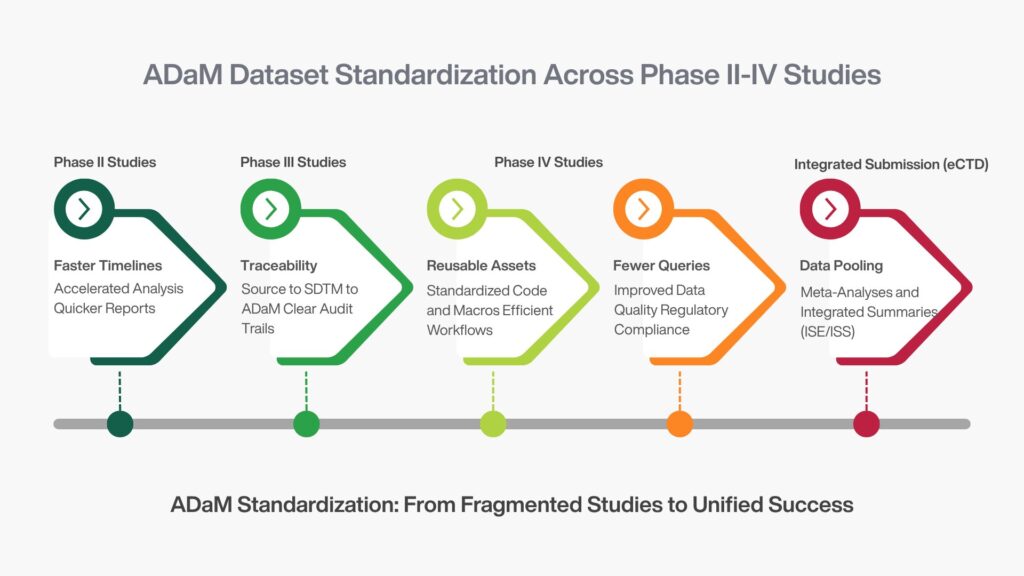
Standardizing ADaM datasets across Phase II to Phase IV studies brings significant advantages that go far beyond simple compliance. When implemented at the program level rather than study-by-study, ADaM becomes a powerful enabler of efficiency and quality.
First, it dramatically accelerates timelines. Teams typically see a 30–50% reduction in programming effort for subsequent studies because standard ADSL and BDS templates can be reused with minimal changes. Database locks happen faster, and integrated summaries (ISS/ISE) can be produced in weeks instead of months.
Second, it ensures full traceability and regulatory friendliness. Every derived variable, flag, and parameter follows consistent rules, making it easy for reviewers at the FDA and PMDA to understand the analysis path from raw SDTM data to final outputs.
Third, it enables seamless data pooling. Consistent use of analysis flags such as TRTEMFL (treatment-emergent), SAFFL (safety population), EFFL (efficacy population), and ANL01FL (analysis record flag) eliminates reconciliation headaches when combining multiple studies.
Fourth, it reduces risk and cost. With standardized derivation rules, variable naming conventions, and metadata, the chances of errors decrease sharply, leading to fewer queries during regulatory review and less rework during validation.
Finally, it improves team productivity. Statisticians and programmers spend less time reinventing the wheel and more time on actual analysis and interpretation, ultimately helping bring medicines to patients faster.
In short, program-wide ADaM standardization transforms data management from a repetitive burden into a strategic advantage that delivers speed, quality, and confidence throughout the drug development journey.
The Regulatory Push: FDA and PMDA Aren’t Negotiating
Since 2017, the FDA has required ADaM (along with SDTM and Define-XML) for studies starting after December 17, 2016 in NDAs, ANDAs, and certain BLAs. PMDA in Japan follows suit. The agency’s Study Data Technical Conformance Guide is crystal clear: ADSL is mandatory, and you must submit the ADaM datasets that support key efficacy and safety analyses. Reviewers now expect traceability, consistent variable naming, and metadata that matches the ADaM Implementation Guide (ADaMIG).
Non-compliance triggers technical rejection. More importantly, inconsistent ADaM slows review. When every study follows the same ADSL structure, same PARAM/PARAMCD conventions, and same derivation rules for flags like TRTEMFL or ANL01FL, reviewers can focus on science instead of data wrangling.
Real-World Challenges (and How to Beat Them)
Standardizing ADaM across phases isn’t plug-and-play. Here are the usual suspects, and proven workarounds:
| Challenge | Description | Impact on Timeline/Quality | Recommended Solution |
| Legacy vs. Prospective Data | Older Phase II studies use custom or “ADaM-like” formats | Rework during pooling; validation delays | Create central ADaM specification template early; use automated conversion tools |
| Therapeutic Area & Design Evolution | Oncology (RECIST), immunology (flares), Phase IV real-world elements differ | Inconsistent derivations across studies | Leverage ADaMIG core + TAUGs; define sponsor-specific extensions with traceability |
| Cross-Study Periods & Subperiods | Multiple protocols with screening, treatment, extension phases | Errors in pooled safety/efficacy analyses | Standardize APHASE, APERIOD, ASPER, TRTxxP variables per ADaM guidelines |
| CRO/Vendor Variability | Different partners interpret “analysis-ready” differently | Inconsistent datasets; extra QC cycles | Mandate single program-level ADaM spec + automated validation (e.g., Pinnacle 21) |
| Complex Derivations & Flags | Varying definitions for treatment-emergent, baseline, analysis sets | Regulatory queries; delayed ISS/ISE | Build reusable derivation library with clear metadata and examples in ADRG |
Legacy vs. prospective data:
Older Phase II studies often arrive in “ADaM-like” format. Converting them retroactively is painful. Solution: Build a central ADaM specification template early and enforce it via a data standards library (tools like Pinnacle 21 Enterprise or open-source R packages help).
Therapeutic-area differences and study design evolution:
Oncology uses RECIST parameters; immunology tracks disease flares; cardiovascular trials need time-to-event derivations. Phase IV registries introduce real-world evidence elements. The fix: Use ADaMIG v1.3 core structures plus Therapeutic Area User Guides (TAUGs) and create sponsor-specific “ADaM extensions” that still follow naming and traceability rules.
Cross-study periods and subperiods:
A subject might have screening, treatment, follow-up, and extension phases across multiple protocols. The 2022 case study on ADaM Phases, Periods, and Subperiods shows how to handle this elegantly with standardized variables like APERIOD, TRTxxP, and subperiod flags, critical for pooled safety analyses.
CRO and vendor variability:
Different partners interpret “analysis ready” differently. Best practice: Mandate a single ADaM specification document and automated validation checks (Pinnacle 21 or custom SAS/R scripts) before data handoff.
Best Practices That Actually Work
Smart sponsors treat ADaM standardization as a capability, not a project:
Start in Phase II:
Define the program-level ADSL and BDS shells before the first patient is enrolled. This forces early decisions on analysis populations, derivation rules, and parameter codes.
Build a reusable library:
Maintain a metadata repository of standard variables, controlled terminology, and derivation algorithms. Update it with each new study.
Automate early and often:
Modern tools let you generate draft ADaM datasets before data collection even finishes. Validation becomes continuous, not a last-minute scramble.
Document like your submission depends on it (because it does):
Use the ADaM Data Reviewer’s Guide (ADRG) and define.xml religiously. Include traceability examples for complex derivations.
Plan for integration from day one:
Design ADaM with pooling in mind, standard flags for analysis sets (SAFFL, EFFL, etc.) and consistent handling of partial dates, missing values, and censoring.
The Payoff: Speed, Quality, and Regulatory Goodwill
Companies that standardize ADaM report tangible wins: reduced programming time by 30-50% on follow-on studies, fewer queries during FDA review, and smoother ISS/ISE production. One mid-sized sponsor I know cut their integrated safety database creation from 12 weeks to 4 by enforcing program-wide ADaM standards across a Phase IIb–III–IV program in immunology.
In an era of accelerated approvals, real-world evidence, and massive multi-study portfolios, ADaM standardization isn’t a nice-to-have. It’s table stakes for efficient drug development.
Looking Ahead
The next frontier? AI-assisted ADaM generation, tighter integration with real-world data sources, and even more sophisticated OCCDS structures for complex safety signals. But the foundation remains the same: consistent, traceable, analysis-ready data that speaks the same language across every phase of development.If you’re still treating ADaM as a per-study exercise, it’s time to rethink. The data you standardize today will save your team, and your timelines, tomorrow.
Read More : CDISC Standards Evolution Supporting Global Data Interoperability
References
- Clinical Data Interchange Standards Consortium (CDISC). (2021). Analysis Data Model Implementation Guide (ADaMIG) Version 1.3. Available at: https://www.cdisc.org/standards/foundational/adam/adamig-v1-3
- U.S. Food and Drug Administration. (2023). Submitting Clinical Trial Datasets and Documentation for Marketing Applications. FDA Guidance. Available at: https://www.fda.gov/media/173587/download
- Jain, V., & Minjoe, S. (2014). A Road Map to Successful CDISC ADaM Submission to FDA: Guidelines, Best Practices & Case Studies. PharmaSUG 2014 Proceedings. Available at: https://pharmasug.org/proceedings/2014/DS/PharmaSUG-2014-DS15.pdf
- Yamamoto, K., et al. (2017). A pragmatic method for transforming clinical research data into a standard format. Journal of Biomedical Informatics. DOI: 10.1016/j.jbi.2017.05.003 (discusses SDTM-to-ADaM transformation and cross-study reuse)
- CDISC ADaM Team. (2022). CDISC ADaM Phases, Periods, and Subperiods: A Case Study. ResearchGate publication. Available at: https://www.researchgate.net/publication/362719778_CDISC_ADaM_Phases_Periods_and_Subperiods_A_Case_Study
Standardization isn’t about bureaucracy, it’s about giving your data the best possible chance to tell its story clearly, quickly, and convincingly. The teams doing it right are already reaping the rewards.
FAQs:
What is the difference between SDTM and ADaM?
SDTM tabulates raw collected data; ADaM creates analysis-ready datasets with derived variables and traceability for statistical analysis.
Is ADaM mandatory for FDA submissions?
Yes. ADSL is required, and ADaM datasets supporting key analyses must be submitted for studies starting after Dec 17, 2016.
When should ADaM standardization start?
Ideally in early Phase II, before the first patient is enrolled, to avoid rework during later pooling for ISS/ISE.
How to handle legacy data and different therapeutic areas?
Use core ADaMIG structures + TAUGs; apply a central specification template and maintain full traceability.
What are the key benefits of program-wide standardization?
30–50% faster programming, reusable templates, fewer regulatory queries, and smoother integrated safety/efficacy analyses.
